
September 17, 2026
connectc1
Every exhibition manager knows the feeling: the event date is locked in, the venue is booked, and the marketing team is waiting on a “final yes” for the stall design — but the approval process keeps dragging on. Emails go back and forth. Feedback gets lost in translation between what the client imagined and what the 2D layout actually shows. Weeks pass, and suddenly the design team is rushing to finalize production with barely any time left.
This is one of the most common bottlenecks in exhibition stand design, and it almost always comes down to one root cause: brands struggle to approve something they can’t clearly visualize.
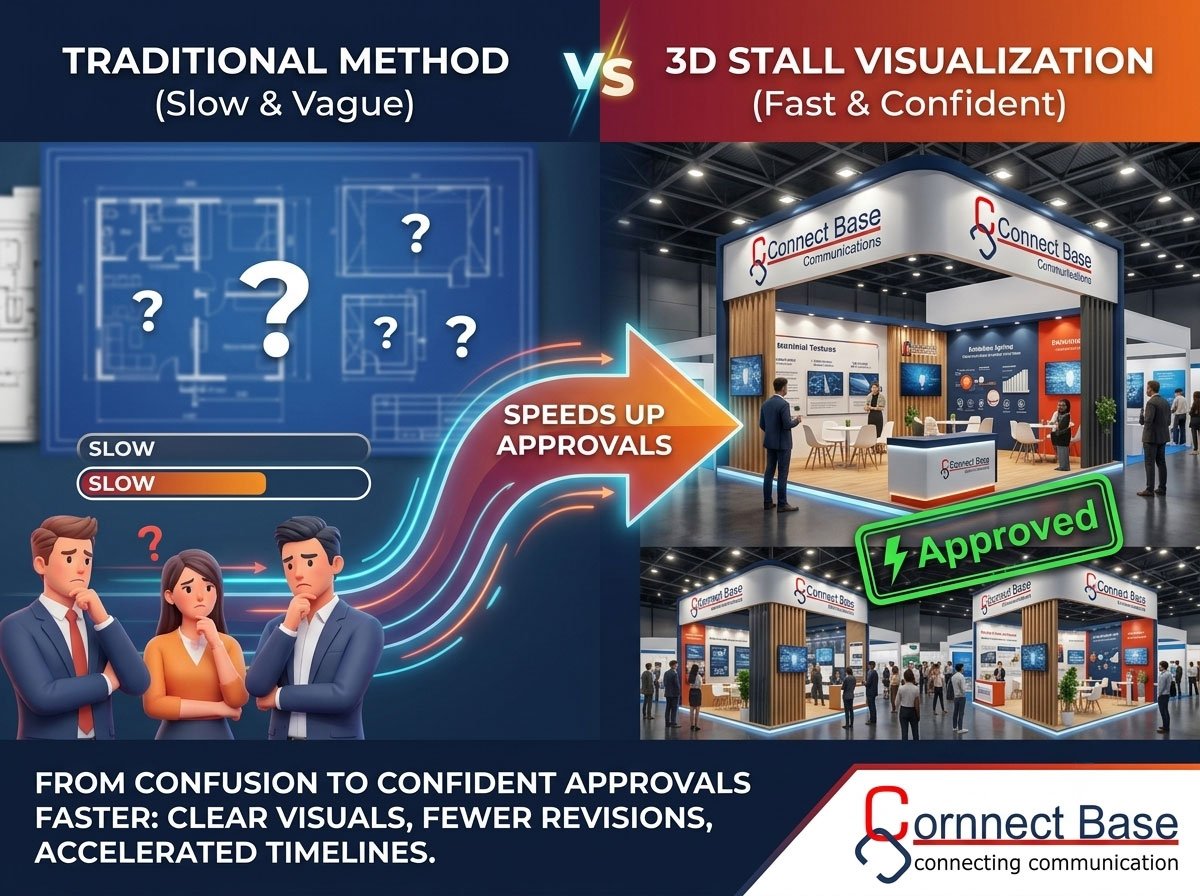
This is exactly where 3D stall visualization changes the game. Instead of relying on flat drawings, technical sketches, or your imagination to fill in the gaps, 3D visualization gives brands a near-photorealistic preview of their exhibition stand before a single panel is fabricated. The result? Faster approvals, fewer revisions, and a much smoother path from concept to the show floor.
In this blog, we’ll break down exactly how 3D stall visualization works, why it has become essential for modern exhibition design, and how it helps brands make confident decisions faster — a process we’ve refined at Connectbase Communications while designing exhibition stalls across industries.
The Traditional Approval Process — And Why It’s So Slow
Before 3D visualization became standard practice, exhibition stand approvals typically followed this path:
- The design team creates a 2D floor plan and elevation drawings.
- These are shared with the brand along with written descriptions of materials, colors, and finishes.
- The brand tries to mentally construct a 3D image from these flat references.
- Feedback is given based on assumptions, not actual visuals.
- The design team revises, often addressing miscommunications rather than genuine design flaws.
- The cycle repeats — sometimes three, four, or five times.
The core problem here isn’t a lack of creativity or design skill. It’s a visualization gap. Most stakeholders — marketing heads, brand managers, procurement teams — aren’t trained to read technical drawings. A 2D plan showing “reception counter, 3m x 1.2m, with backlit logo panel” doesn’t mean much to someone who needs to picture how that counter will look, feel, and function on the actual show floor.
This gap leads to delayed sign-offs, last-minute changes, and in worst cases, a stall that doesn’t match expectations even after approval — discovered only during on-site build, when it’s too expensive and too late to fix.
What Is 3D Stall Visualization?
3D stall visualization is the process of creating a realistic, three-dimensional digital model of an exhibition stand before it is physically built. Using specialized 3D design and rendering software, designers translate the floor plan, branding guidelines, and material specifications into a visual representation that closely mirrors how the final stand will actually look.
Modern 3D visualization can include:
- Photorealistic renders from multiple angles, showing lighting, textures, and finishes
- 360-degree walkthroughs that simulate walking through the stand
- Day and night lighting previews to show how the booth performs under exhibition hall lighting
- Branding mockups with logos, signage, and graphics placed exactly as they’ll appear
- Furniture and fixture previews, including seating, counters, and display units
- Virtual reality (VR) walkthroughs for an immersive, first-person preview in advanced projects
Rather than asking a client to imagine the finished stand from a technical drawing, 3D visualization shows them almost exactly what they’re going to get.
How 3D Visualization Speeds Up the Approval Process
1. It Eliminates Guesswork From Client Feedback
When a brand can see a fully rendered version of their stall, feedback becomes specific and actionable. Instead of vague comments like “can we make it feel more premium?”, clients can point directly at elements: “the counter finish looks too dark,” or “can the logo panel be moved slightly left?” This precision means design revisions address real concerns rather than miscommunications, cutting down the number of review cycles significantly.
2. Stakeholders Can Align Faster — Even Remotely
Exhibition decisions rarely rest with just one person. Marketing heads, brand managers, regional teams, and sometimes global headquarters often need to sign off. A 3D render or walkthrough can be shared as a single visual reference that everyone reviews together, whether in a meeting room or across time zones. This shared visual context prevents the “telephone game” effect where feedback gets diluted or misunderstood as it passes between stakeholders.
3. It Builds Confidence in the Design Investment
Exhibition stands are a significant marketing spend, and decision-makers want assurance before committing budget. Seeing a realistic 3D preview reduces the perceived risk of approval. Brands feel more confident saying “yes” when they can actually see the return on their investment rendered in front of them, rather than trusting a description on paper.
4. It Surfaces Design Issues Before Fabrication Begins
3D visualization isn’t just useful for the client — it’s a powerful internal quality-control tool for the design team as well. Spatial problems, awkward sightlines, lighting conflicts, or branding placement issues are often invisible in a 2D plan but immediately obvious in a 3D render. Catching these issues at the visualization stage means they’re fixed digitally, at zero cost, rather than discovered during physical construction, where changes are expensive and time-consuming.
5. It Reduces Costly On-Site Surprises
One of the most damaging outcomes in exhibition design is a brand walking onto the finished stall and feeling it doesn’t match what they approved. This usually stems from ambiguity in earlier approval stages. Because 3D visualization closely mirrors the final structure, materials, and branding, there’s very little room for surprises. What’s approved on screen is what shows up on the exhibition floor.
6. It Speeds Up Vendor and Contractor Alignment
3D visuals aren’t only useful for client approval — they also help fabrication teams, electricians, and on-site contractors understand exactly what needs to be built. This shared visual reference minimizes miscommunication during production, further shortening the overall project timeline.
Real-World Impact: From Weeks to Days
In our experience at Connectbase Communications, exhibition stall projects that once required three to four rounds of revisions — often spanning two to three weeks — are frequently approved within a single review cycle once photorealistic 3D visuals are introduced early in the process. Brands can see color accuracy, spatial proportions, lighting mood, and branding placement all at once, which drastically shortens the back-and-forth that traditionally slows down exhibition stand design projects.
This speed advantage becomes especially valuable when:
- The exhibition date is fixed and non-negotiable
- Multiple stakeholders across departments or countries need to approve the design
- The brand is entering a new market and wants precise control over first impressions
- The stall design includes custom or intricate structural elements that are hard to describe in words
Why 3D Visualization Matters More Than Ever in Competitive Exhibitions
Exhibition halls today are more crowded and visually competitive than ever. Brands aren’t just building a stall — they’re building a three-dimensional brand experience that needs to stand out among dozens of competing exhibitors. Getting that experience right the first time, without delays eating into preparation time, is critical.
3D visualization also supports better decision-making around:
- Traffic flow — how visitors will move through and interact with the space
- Focal points — ensuring the brand’s key message or product is the visual anchor
- Lighting strategy — since exhibition hall lighting varies widely and can dramatically change how a stall appears
- Material selection — comparing finishes like matte vs. gloss, wood vs. metal, before committing to procurement
By addressing these factors visually and early, brands walk into the fabrication stage with total clarity, and design teams can move straight into production without pausing for repeated clarifications.
What to Look for in a 3D Visualization Process
If you’re evaluating exhibition stand design partners, here are a few things worth asking about their 3D visualization capabilities:
- Do they provide multiple-angle renders, or just a single hero shot?
- Can they simulate different lighting conditions (daytime hall lighting vs. spotlighting)?
- Do they offer 360-degree or walkthrough previews for more complex stalls?
- How quickly can they turn around revisions after feedback?
- Do their 3D renders closely match their final built projects (ask for past examples)?
A design partner who invests properly in 3D visualization isn’t just making pretty pictures — they’re building a communication bridge that protects your budget, timeline, and brand reputation.
How Connectbase Communications Uses 3D Visualization
At Connectbase Communications, 3D stall visualization is built into our design process from the very first concept stage — not added as an afterthought. Every exhibition stand design we create moves through detailed 3D modeling before we present it for client approval, ensuring that what you see is what gets built.
Our approach typically includes:
- Concept renders showing overall structure, branding, and layout
- Multiple-angle views to fully represent the stall’s design from every visitor perspective
- Lighting previews tailored to typical exhibition hall environments
- Revision-ready 3D files so feedback can be implemented and re-rendered quickly
This process is part of our broader exhibition stall design services, which cover everything from custom stall fabrication to turnkey exhibition booth solutions for brands across industries.
Final Thoughts
Exhibition timelines are tight, budgets are significant, and brand reputation is on the line every time a company steps onto a show floor. 3D stall visualization removes the ambiguity that traditionally slows down design approvals, replacing guesswork with clarity and back-and-forth emails with confident, informed sign-offs.
For brands looking to move faster without compromising on design quality, partnering with a team that prioritizes 3D visualization isn’t just a nice-to-have — it’s a strategic advantage.
If you’re planning an upcoming exhibition and want a design process that gets you from concept to confident approval faster, get in touch with Connectbase Communications or visit www.connectbasecommunications.com to see our exhibition stall design portfolio.
