
Introduction
Exhibitions and trade shows remain one of the most powerful platforms for brands to showcase their products, connect with prospective clients, and strengthen their market presence. However, behind every eye-catching exhibition stall lies a complex process of planning, designing, and fabrication — a process that, if mismanaged, can lead to costly errors, wasted materials, and last-minute chaos on the show floor.
This is where 3D exhibition stall design has become a game-changer for the exhibition industry. Instead of relying on flat 2D sketches or vague verbal briefs, brands and fabricators now use highly detailed 3D visualizations to plan every element of a stall — from structural framework to lighting, branding, and furniture placement — before a single piece of material is cut.
At Connectbase Communication, we have seen firsthand how integrating 3D design into the exhibition stall development process significantly reduces fabrication errors and helps clients save on overall project costs. In this article, we’ll explore exactly how 3D exhibition stall design works, why it matters, and how it directly impacts your bottom line.
What Is 3D Exhibition Stall Design?
3D exhibition stall design is the process of creating a realistic, three-dimensional digital model of an exhibition stand before it goes into physical production. Using advanced design software, designers build a virtual replica of the stall — complete with accurate measurements, materials, textures, lighting effects, and branding elements.
Unlike traditional 2D floor plans or hand-drawn concepts, a 3D model allows clients and fabrication teams to:
- View the stall from every angle, including walkthroughs
- Understand spatial relationships between different zones (reception, product display, meeting areas, storage)
- Visualize how lighting, colors, and materials will actually look
- Identify design flaws or impractical elements before production begins
- Make real-time adjustments without additional fabrication cost
This shift from imagination-based planning to visualization-based planning is the foundation of why 3D design has become indispensable in the exhibition industry.
The Traditional Problem: Fabrication Errors and Cost Overruns
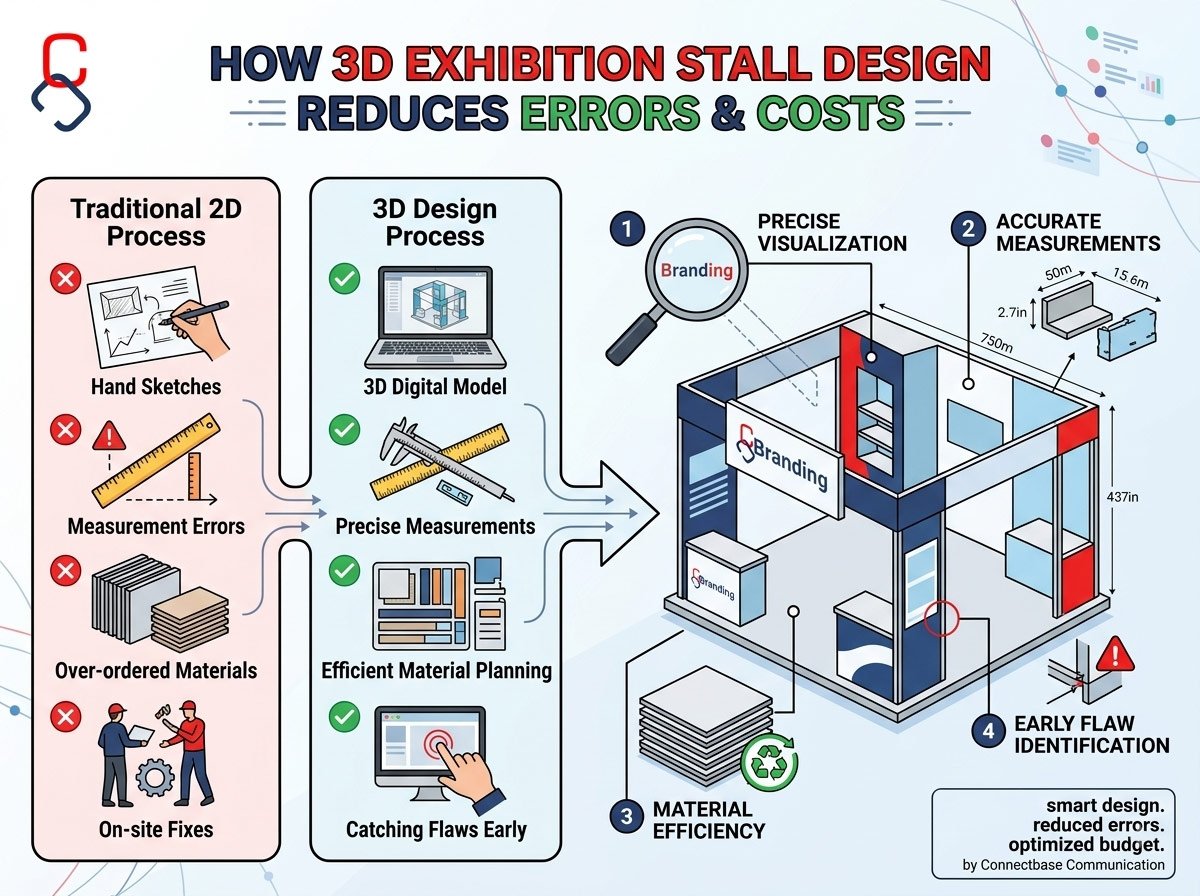
Before 3D design became standard practice, exhibition stalls were often built based on 2D drawings, rough sketches, or verbal descriptions. This approach left significant room for misinterpretation. Common issues included:
1. Measurement Mismatches
A wall panel designed on paper might not translate accurately to the physical build, resulting in structural components that don’t fit together properly.
2. Material Miscalculations
Without a precise 3D reference, fabricators often over-order or under-order materials, leading to waste or last-minute shortages.
3. Design Miscommunication
Clients often struggled to visualize the final look from 2D plans, leading to disappointment or last-minute change requests — often after fabrication had already begun.
4. Structural Feasibility Issues
Some design elements that look good on paper are simply not feasible to construct within budget, time, or safety constraints. These issues were often discovered too late.
5. Costly On-Site Modifications
When errors were discovered during installation, teams had to make on-the-spot changes — often at premium rates due to time pressure, transportation of new materials, and additional labor.
These issues collectively contributed to increased costs, delayed timelines, and stressed relationships between clients and fabrication teams.
How 3D Exhibition Stall Design Solves These Problems
1. Precise Visualization Reduces Miscommunication
One of the biggest advantages of 3D design is that it eliminates guesswork. Clients can see an accurate representation of their stall before approving the final design. This means:
- Fewer revision cycles after fabrication has started
- Clear alignment between client expectations and the fabrication team’s execution
- Reduced back-and-forth communication delays
At Connectbase Communication, our 3D design process ensures that what the client sees on screen is exactly what gets built on the exhibition floor — down to the smallest branding detail.
2. Accurate Measurements Minimize Structural Errors
3D design software allows designers to work with exact dimensions, ensuring that every wall, panel, counter, and display unit is created to precise specifications. This drastically reduces the chances of components not fitting together during assembly.
When measurements are accurate from the design stage itself, fabrication teams can pre-cut and pre-fabricate materials with confidence, minimizing on-site adjustments.
3. Material Planning Becomes More Efficient
With a detailed 3D model, project managers can calculate the exact quantity of materials required — whether it’s MDF panels, vinyl graphics, flooring, or lighting fixtures. This precise planning helps:
- Avoid over-ordering (which leads to wasted budget)
- Prevent under-ordering (which causes production delays)
- Streamline procurement and reduce last-minute purchasing at higher costs
Efficient material planning is one of the most direct ways 3D design contributes to lower exhibition stall project costs.
4. Early Identification of Design Flaws
A 3D model allows designers and engineers to spot potential structural or logistical issues long before fabrication begins. For example:
- Identifying if a proposed structure exceeds venue height restrictions
- Checking whether walkways and product display areas allow smooth visitor flow
- Ensuring electrical and lighting placements are practical and safe
Catching these issues at the design stage — rather than during fabrication or installation — saves significant time, labor, and material costs.
5. Better Collaboration Between Teams
3D exhibition stall design creates a shared visual reference point for everyone involved in the project — from the client and creative team to structural engineers, electricians, and on-site installation crews. When everyone is working from the same accurate 3D model, there is far less room for misunderstanding or conflicting interpretations of the design brief.
6. Faster Approvals, Faster Execution
Because clients can visualize the final result clearly, approval cycles are significantly shortened. Instead of multiple rounds of clarification and revision, most feedback can be addressed directly within the 3D model itself. This accelerates the overall project timeline, which is especially valuable when working with tight exhibition deadlines.
7. Virtual Walkthroughs Improve Decision-Making
Advanced 3D design also allows for virtual walkthroughs, giving clients a near-realistic sense of how visitors will experience the stall. This helps in making smarter decisions about traffic flow, product placement, and overall visitor engagement — decisions that are far more difficult to make from static 2D layouts.
The Direct Cost-Saving Benefits of 3D Exhibition Stall Design
Let’s break down exactly where the cost savings come from when using 3D design in exhibition stall fabrication:
| Cost Factor | Traditional 2D Process | 3D Design Process |
|---|---|---|
| Material Waste | High, due to estimation errors | Low, due to precise planning |
| Revision Costs | High, revisions often happen post-fabrication | Low, revisions happen digitally before production |
| On-Site Modifications | Frequent and expensive | Rare, since issues are caught early |
| Labor Overtime | Common due to last-minute fixes | Reduced, as fabrication follows an accurate plan |
| Client Approval Delays | Longer, due to unclear visualization | Shorter, due to realistic previews |
| Transportation of Extra Materials | Additional unplanned costs | Minimized through accurate quantity planning |
When you add up these factors across a full exhibition project, the savings from using 3D design can be substantial — often making the difference between a profitable project and a budget overrun.
Why This Matters More for Custom Exhibition Stalls
Custom-built exhibition stalls, as opposed to standard modular setups, involve unique structures, bespoke branding elements, and often intricate design features. This complexity increases the risk of fabrication errors if the process relies solely on traditional planning methods.
3D design is particularly valuable for custom stalls because it allows:
- Complex geometric structures to be tested virtually before physical construction
- Multiple design iterations without incurring material costs
- Precise integration of branding elements like logos, digital screens, and product displays
- Better coordination between multiple vendors (structural fabricators, electricians, graphic printers)
For brands investing in a fully customized exhibition presence, 3D design isn’t just a nice-to-have — it’s essential for controlling both quality and budget.
How Connectbase Communication Uses 3D Design to Deliver Better Results
At Connectbase Communication, our exhibition stall design process is built around a 3D-first approach. Here’s how we ensure our clients benefit from reduced errors and optimized costs:
- Detailed Client Briefing: We begin by understanding your brand, objectives, and space requirements in depth.
- 3D Conceptualization: Our design team creates multiple 3D concepts, allowing you to compare layouts, color schemes, and branding placements.
- Realistic Rendering: We provide photorealistic renders and walkthroughs so you can visualize the stall exactly as it will appear on-site.
- Collaborative Revisions: All design feedback is incorporated digitally, avoiding costly post-fabrication changes.
- Precise Fabrication Planning: Once the 3D design is finalized, our production team uses it as the exact blueprint for material sourcing and fabrication.
- Quality-Controlled Execution: Because every element has already been tested virtually, our on-site installation process is smoother, faster, and more cost-efficient.
This structured process has helped numerous clients avoid the common pitfalls of exhibition stall fabrication — saving both time and budget while delivering a polished final result.
Additional Benefits Beyond Cost Savings
While cost reduction and error minimization are major advantages, 3D exhibition stall design also offers additional benefits:
- Stronger Brand Representation: A well-visualized stall ensures your branding is consistent and impactful.
- Better Space Utilization: 3D planning helps optimize every square foot of your allotted exhibition space.
- Improved Visitor Experience: Thoughtful layout planning leads to smoother visitor flow and better engagement.
- Sustainability: Reduced material waste also contributes to more environmentally responsible exhibition practices.
Tips for Brands Planning Their Next Exhibition Stall
If you’re preparing for an upcoming trade show or exhibition, here are a few practical tips to make the most of 3D exhibition stall design:
- Start the Design Process Early: Give your design team enough time to create and refine 3D concepts before finalizing fabrication.
- Provide Clear Branding Guidelines: Share your brand assets, color palette, and messaging priorities upfront.
- Review Every Angle: Don’t just look at the front view — request walkthroughs and multiple perspectives to catch potential issues.
- Confirm Measurements Against Venue Specifications: Always cross-check the 3D design with actual venue dimensions and restrictions.
- Lock the Design Before Fabrication Begins: Avoid making major changes once fabrication starts, as this is where costs tend to escalate.
Conclusion
3D exhibition stall design has transformed the way exhibition stands are planned, approved, and fabricated. By replacing guesswork with precise visualization, brands can significantly reduce fabrication errors, avoid unnecessary material waste, and keep their project budgets under control.
At Connectbase Communication, we combine creative design expertise with a technology-driven approach to deliver exhibition stalls that are not only visually stunning but also cost-efficient and error-free in execution. Whether you’re planning a compact booth or a large custom pavilion, our 3D-first design process ensures your vision is translated accurately — on time and within budget.
Ready to design your next exhibition stall the smart way?
Visit us at www.connectbasecommunications.com or reach out directly at bhavesh.connectbase@gmail.com to discuss your upcoming project with our design team.
Frequently Asked Questions (FAQs)
Q1. What is 3D exhibition stall design? 3D exhibition stall design is the process of creating a realistic three-dimensional digital model of an exhibition stand, allowing clients and fabricators to visualize the final structure before physical production begins.
Q2. How does 3D design reduce fabrication costs? It reduces costs by minimizing material waste, avoiding on-site modifications, shortening approval cycles, and catching design flaws early — all of which prevent expensive last-minute changes.
Q3. Is 3D design necessary for small exhibition stalls too? Yes. Even smaller stalls benefit from 3D design, as it ensures accurate space utilization, correct branding placement, and error-free fabrication regardless of stall size.
Q4. How long does the 3D design process take? Timelines vary based on complexity, but most 3D concepts and revisions can be completed well within standard exhibition planning schedules when started early.
Q5. Can I request changes after seeing the 3D design? Absolutely. The biggest advantage of 3D design is that revisions can be made digitally before fabrication, saving both time and cost compared to physical changes.
Connectbase Communication specializes in custom exhibition stall design and fabrication, helping brands create impactful, cost-efficient, and error-free exhibition experiences. Contact us at bhavesh.connectbase@gmail.com or visit www.connectbasecommunications.com to start planning your next stall.
