
September 14, 2026
connectc1
Walk down any exhibition hall aisle and you’ll notice something interesting: out of hundreds of stalls competing for attention, only a handful actually stop visitors in their tracks. The rest blend into the background, no matter how much money went into building them.
So what separates a stall that converts foot traffic into genuine business leads from one that simply takes up floor space? The answer isn’t luck, and it isn’t just about having the biggest booth on the show floor. It comes down to deliberate design choices — decisions about layout, branding, lighting, technology, and visitor experience that work together to guide people from curiosity to conversation to conversion.
At Connectbase Communications, we’ve spent years designing exhibition stalls for brands across industries, and we’ve seen firsthand what separates a forgettable booth from a high-performing one. In this guide, we’re breaking down the exact design elements that drive real results — so your next exhibition investment pays off in qualified leads, not just impressions.
Why Exhibition Stall Design Directly Impacts ROI
Before we get into specific elements, it’s worth understanding why design matters as much as it does. An exhibition is a high-cost, time-limited opportunity. You’re paying for floor space, travel, staffing, printed materials, and often a custom build — all for a few days of visibility. If your stall doesn’t actively work to attract, engage, and convert visitors, that investment is largely wasted.
A well-designed stall does three things simultaneously:
- Captures attention from a distance, in a crowded, visually noisy environment.
- Communicates your value proposition within seconds, before a visitor even speaks to your team.
- Creates a physical journey that naturally leads visitors toward a conversation, a demo, or a sign-up.
Every element we discuss below serves at least one of these three functions. When they work together, your stall stops being a static display and starts functioning as a conversion tool.
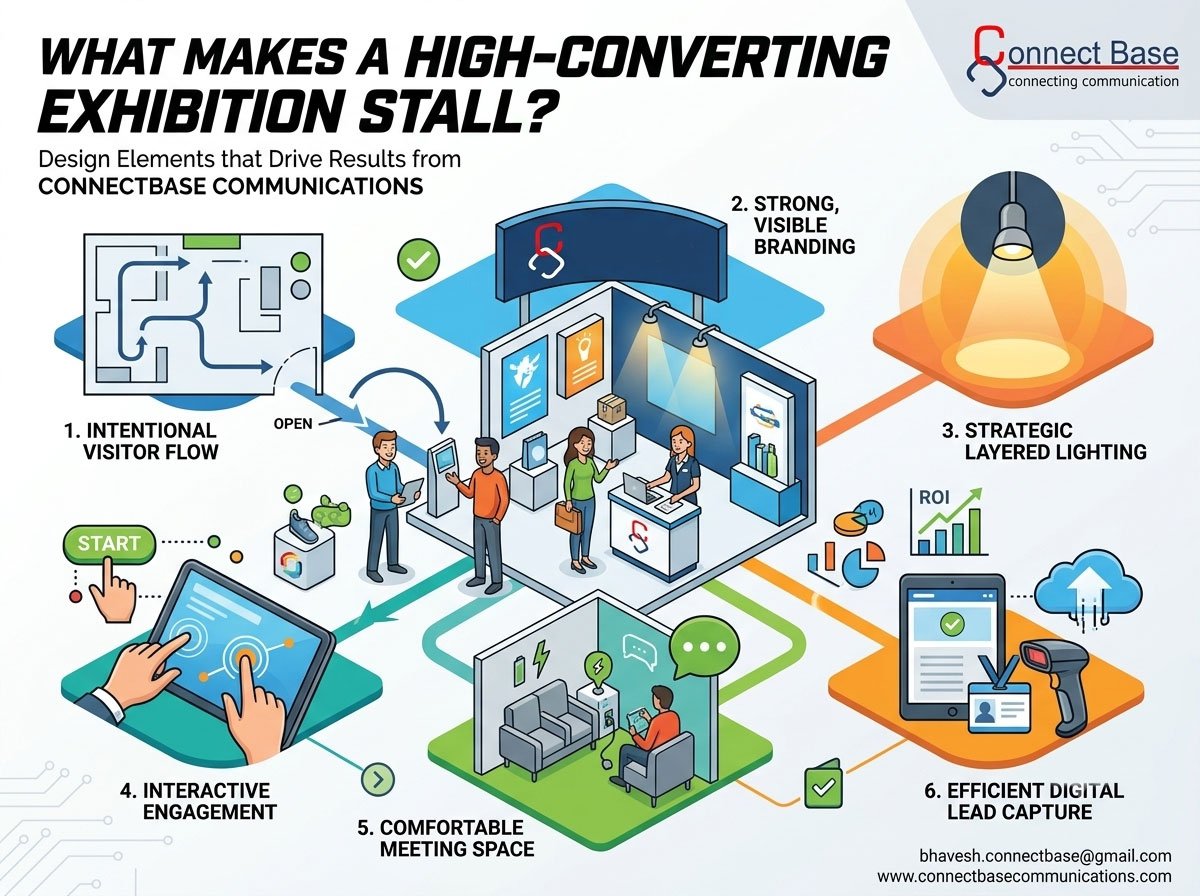
1. A Layout That Guides Visitor Flow
The single biggest mistake we see in poorly performing stalls is a layout with no intentional flow. Visitors wander in, don’t know where to look, and leave without engaging.
High-converting stalls are designed with a clear visitor journey in mind:
- Open, inviting entry points rather than closed-off counters that create a barrier between staff and visitors.
- A natural path that moves people from an eye-catching display area, to an interactive or product zone, to a private conversation or meeting space.
- Clear zoning — a welcome area, a demonstration area, and a discussion area — so visitors always know what to do next.
This is exactly the thinking behind our custom exhibition stall design services, where every layout is planned around how visitors will actually move through the space, not just how the stall looks in a rendering.
2. Strong, Consistent Branding Visible From a Distance
You typically have three to five seconds to catch a visitor’s eye as they walk past. That means your branding needs to be legible and recognizable from 15–20 feet away, not just up close.
Elements that make branding work at a distance include:
- Bold, high-contrast logo placement at eye level and above head height.
- A consistent color palette that matches your overall brand identity, not a exhibition-only “theme.”
- Large-format graphics that communicate your core message in a single glance — think a headline benefit, not a paragraph of text.
- Backlit or illuminated signage that stands out under the mixed lighting conditions of most exhibition halls.
Consistency matters too. If your booth’s branding doesn’t match your website, brochures, or sales materials, you create a subtle sense of distrust. Visitors should feel like they’re stepping into the same brand they’ve researched online.
3. Lighting That Does More Than Illuminate
Lighting is one of the most underrated tools in exhibition design. Beyond simply making your stall visible, the right lighting setup can:
- Draw the eye toward key products, graphics, or focal displays.
- Create a warmer, more premium atmosphere compared to the harsh overhead lighting of a typical exhibition hall.
- Highlight your brand colors and materials, making finishes look richer and more considered.
Layered lighting — a mix of ambient, accent, and task lighting — consistently outperforms single-source overhead lighting in both attention-grabbing power and perceived stall quality. If you’re planning a stand for an upcoming show, our stall lighting and structural design solutions are built specifically to make your brand pop under real hall conditions.
4. Interactive Elements That Encourage Engagement
Static displays get glanced at. Interactive elements get remembered — and more importantly, they give your staff a natural reason to start a conversation.
High-converting stalls often include:
- Touchscreen product demos or configurators visitors can control themselves.
- Live product demonstrations at scheduled intervals to draw a crowd.
- Simple gamification — spin-the-wheel promotions, quizzes, or contests tied to lead capture.
- AR/VR experiences for brands with complex or hard-to-visualize products.
The goal isn’t novelty for its own sake. Every interactive element should tie back to your core message and give your team a reason to approach a visitor with a relevant, low-pressure opening line.
5. Comfortable, Purposeful Meeting Spaces
Once you’ve captured attention, you need somewhere to have a real conversation. Stalls that convert well almost always include a dedicated meeting or lounge area — separate from the busy walkway — where staff can sit down with a genuinely interested prospect without competing with hall noise and foot traffic.
Key considerations for this space:
- Comfortable seating that encourages visitors to stay longer.
- Semi-private positioning, using structural elements or greenery rather than solid walls that feel closed off.
- Charging points and small refreshments, which give visitors a practical reason to linger.
This is where casual interest often turns into a qualified lead, which is why we treat meeting-zone design as a core part of every exhibition stand build we deliver, not an afterthought bolted onto the floor plan.
6. Clear, Benefit-Led Messaging
Visitors don’t read paragraphs on a trade show floor — they scan. That means your key messaging needs to be reduced to its sharpest, most benefit-focused form.
Effective exhibition messaging typically follows this structure:
- A short, bold headline stating the core benefit or transformation you offer.
- One supporting line that adds credibility or specificity (a number, a result, a differentiator).
- Minimal additional copy, with details reserved for staff conversations or printed leave-behinds.
If your messaging currently reads like a product brochure, it’s worth revisiting before your next show. Clarity beats cleverness every time on the exhibition floor.
7. Materials and Finishes That Reflect Brand Quality
The materials used in your stall construction quietly communicate a lot about your company. Cheap-looking laminates, visible seams, and flimsy structures suggest a company that cuts corners — even if that’s not true.
Premium finishes, well-fitted joinery, and considered material choices (wood tones, matte versus gloss surfaces, fabric textures) signal quality and attention to detail before a single word is spoken. This is particularly important for B2B brands, where buyers are subconsciously evaluating reliability and professionalism through every visual cue available.
8. Technology Integration for Lead Capture
A high-converting stall doesn’t just attract visitors — it captures their information efficiently. Relying on paper forms or business-card bowls in 2026 is a missed opportunity.
Modern stalls typically integrate:
- Digital lead-capture apps or badge-scanning tools used consistently by every staff member.
- QR codes linked to brochures, product pages, or booking forms, placed at multiple touchpoints around the stall.
- Screens displaying live social proof, testimonials, or case study snippets.
The data you collect is only as good as the system capturing it, so this should be planned into your stall design from day one, not added as an afterthought during setup.
9. Staff Positioning and Stall Ergonomics
Even the best-designed stall underperforms if staff are positioned awkwardly — hidden behind counters, clustered in a corner, or standing with their backs to the aisle. Good exhibition design accounts for where staff will naturally stand, how they’ll approach visitors, and how storage, refreshments, and personal items stay out of sight.
Practical ergonomic touches include:
- Discreet storage for bags, coats, and promotional stock.
- Standing-height counters positioned to invite conversation rather than block it.
- Enough open floor space that staff aren’t forced to hover awkwardly near the entrance.
10. A Design That’s Built for Your Specific Audience and Industry
Finally, there’s no single “correct” formula for exhibition stall design — the right approach depends heavily on your industry, audience, and goals. A stall built to sell industrial machinery to procurement managers looks very different from one designed to generate consumer interest in a lifestyle product. Understanding your specific exhibition category is a critical first step before any design work begins.
At Connectbase Communications, we work across a wide range of exhibition stall design categories, tailoring layout, materials, and interactive elements to match how your specific audience behaves on the show floor.
Bringing It All Together
A high-converting exhibition stall isn’t the result of one clever idea — it’s the outcome of dozens of small, deliberate design decisions working in harmony. Layout guides movement. Branding captures attention. Lighting sets the mood. Interactive elements spark curiosity. Comfortable meeting spaces turn interest into conversation. And clean, efficient lead capture ensures none of that effort goes to waste after the show ends.
If you’re planning your next exhibition and want a stall designed specifically to convert visitors into leads — not just look good in photographs — our team at Connectbase Communications can help you plan, design, and build it from the ground up.
Get in touch: Reach out to us at bhavesh.connectbase@gmail.com or explore our full range of services at www.connectbasecommunications.com to start planning your next high-impact exhibition stand.
Related Services
- Custom Exhibition Stall Design
- Exhibition Stand Fabrication
- Exhibition Stall Lighting & Structural Design
- Portable & Modular Exhibition Stands
- Browse All Exhibition Stall Categories
