
October 1, 2026
connectc1
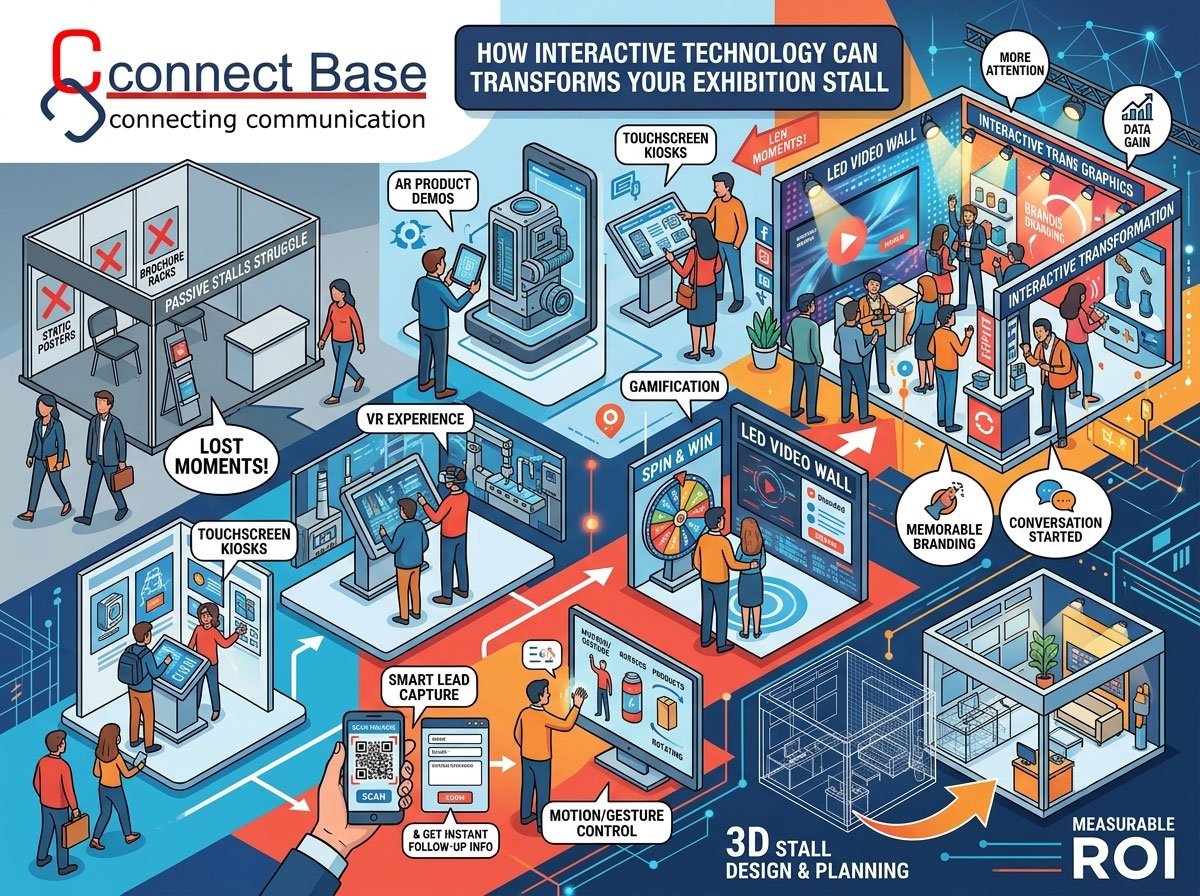
Walk through any major trade fair today and you will notice a clear pattern. The stalls that are crowded and buzzing are rarely the ones with the biggest banners. They are the ones where visitors can do something: tap a screen, try on a virtual product, spin a 3D model, or play a short game and win a reward.
That is the power of interactive technology. A modern interactive exhibition stall does more than display products. It starts conversations, holds attention, gathers data and leaves a lasting impression. In a hall with hundreds of competing brands, that difference decides who gets remembered.
At Connectbase Communications, we have seen brands change their results by moving from a passive display to an engaging, technology-led experience. In this guide we explain how interactive technology can transform your exhibition stall, which tools deliver the best results, and how to plan the investment so it pays off.
Why Passive Stalls Struggle to Compete
Most visitors give a stall only a few seconds before deciding whether to walk in. Static posters, brochure racks and product shelves have to work very hard to win that moment, and they usually lose to something that moves, lights up or invites participation.
The problems with passive stalls are well known:
- Short attention spans: Visitors are tired, overloaded with information and moving fast.
- One-way communication: Your team talks and the visitor listens, which feels like a sales pitch rather than an experience.
- Poor recall: People remember what they experienced, not what they were told.
- No measurable data: You cannot easily tell who engaged, for how long, or with which product.
Interactive technology addresses each of these problems directly. It turns visitors from spectators into participants.
What Is Interactive Technology in an Exhibition Stall?
Interactive technology means any digital or physical element that responds to the visitor’s actions. Instead of only showing information, it reacts to touch, motion, voice, gestures or a smartphone scan.
Common examples include:
- Touchscreen kiosks and interactive displays
- Augmented reality (AR) product demos
- Virtual reality (VR) experiences
- Projection mapping and LED video walls
- Motion-sensor and gesture-based installations
- QR code and NFC-based content
- Gamification and lucky draw systems
- Digital lead capture and badge scanning
Used well, these tools do not replace good design. They sit inside it. That is why interactive planning should begin at the stall design stage, not after the structure is finished.
1. Touchscreen Kiosks: The Digital Product Catalogue
Touchscreens are the easiest entry point into interactivity, and they remain one of the most effective. A well-designed kiosk lets visitors explore your complete range at their own pace, without waiting for a team member to become free.
Benefits:
- Visitors can browse products, specifications, videos and case studies on demand.
- Your sales team is freed up for high-value conversations.
- You can update content instantly, even during the show.
- You can track which products attract the most attention.
Tip: Keep the interface simple. Large buttons, clear categories and short videos work better than dense menus. If a visitor cannot find what they want in about ten seconds, they will walk away.
2. Augmented Reality: Show What Cannot Be Carried
AR is a strong tool for brands with large, heavy or complex products. Machinery, furniture, building materials and industrial equipment are difficult to ship and set up in a stall. With AR, visitors can point a tablet or phone and see a full-scale product appear in front of them, rotate it, and look inside it.
Where AR works best:
- Industrial machinery and engineering products
- Real estate and architecture
- Interior design and modular furniture
- Automotive and heavy equipment
- Education and training solutions
AR also makes a strong social media moment. Visitors who enjoy an experience tend to film it and share it, which extends your reach beyond the hall.
3. Virtual Reality: Create Immersion
VR takes visitors somewhere else entirely. A headset can place them inside a factory, on a construction site, or in a finished building before a single brick is laid.
VR is more resource-intensive than other options, because it needs hardware, space and trained staff. But for premium, high-ticket products it can create an emotional impact that is hard to match. Plan for queue management, hygiene routines for headsets and a short demo of around two to three minutes so that more visitors get a turn.
4. LED Video Walls and Projection Mapping
Lighting and visuals attract people from a distance. A high-resolution LED wall or a projection-mapped structure can show your brand story, product demonstrations and live social feeds at a scale that no printed graphic can match.
Design considerations:
- Place screens at eye level or above the crowd line so that they are visible from the aisle.
- Use short, looping content with strong visuals and minimal text.
- Avoid heavy sound. Hall noise is already high, so use captions and visual cues.
- Match the screen brightness and colour with your branding and lighting plan.
This works best when it is integrated with your stall graphics. For guidance on keeping visuals clear and easy to read, see our post on How to Design Exhibition Stall Graphics That Visitors Can Understand Quickly.
5. Gamification: Make Engagement Fun
Games, quizzes, spin wheels and digital challenges encourage visitors to stay longer and share their details willingly. Because people are having fun, the conversation feels natural rather than pushy.
Ideas that work well:
- A product-knowledge quiz with a small prize
- A digital spin-the-wheel linked to a lead form
- A scavenger hunt across several stalls or zones
- A leaderboard displayed on a screen to create friendly competition
- A photo booth with branded frames and instant sharing
The key is to link the game to a goal. Every interaction should either teach the visitor something about your brand or capture a useful lead.
6. Smart Lead Capture: Turn Engagement into Business
Interactive technology becomes truly valuable when it feeds your sales pipeline. Digital lead capture replaces the pile of business cards and handwritten notes that often get lost after the show.
Options include:
- QR codes that open a quick enquiry form on the visitor’s phone
- NFC tags for tap-to-connect contact sharing
- Badge scanners that sync with your CRM
- Tablets at the reception counter for fast, guided sign-ups
You can then follow up within days, with personalised messages based on the products each visitor explored. Fast, relevant follow-up is one of the biggest factors in turning exhibition leads into customers.
7. Motion and Gesture Installations
Motion sensors and gesture-control systems create a sense of wonder. A visitor waves a hand and a product rotates on a screen. They step onto a floor sensor and a display changes. These small moments make a stall feel alive and modern, and they attract curious passers-by who want to see what is happening.
They are especially effective at the entrance of a stall, where they can pull people in from the aisle.
How Interactive Technology Changes Stall Design
Technology cannot simply be added to any stall. It needs to be planned together with the structure, flow, lighting and branding. Here is how it influences each part of the design.
Layout and Visitor Flow
Interactive zones need space. A kiosk placed too close to the aisle can block foot traffic, while a VR demo hidden at the back may never be used. A good exhibition stall design places high-attraction items near the front to draw people in and moves deeper discussions to quieter areas at the rear.
Power, Wiring and Infrastructure
Screens, sensors and servers need reliable power, cable management and ventilation. Cables should be hidden within the structure for a clean finish, and backup power should be considered for critical displays. This is where careful stall fabrication matters, because the structure must be built to hold the equipment securely and safely. Explore our Exhibition Stall Fabrications service to see how we build for this.
Lighting
Screens and projections need balanced lighting. Too much ambient light washes out displays, while too little makes the stall feel dark and unwelcoming. A lighting plan should account for both the digital elements and your physical products.
Branding and Visual Consistency
Technology should reinforce your brand, not distract from it. The colours, fonts and tone of your digital content should match your stall graphics, signage and printed material, so that the whole experience feels connected.
Surface Materials
Touch points such as kiosks, counters and display bases see heavy use during a show. Choosing durable, easy-to-clean finishes helps the stall look fresh through the final day. For help with this, read our guide on How to Choose the Right Surface Finish for an Exhibition Stall.
The Role of 3D Design in Planning Interactive Stalls
Before you invest in technology, you should see how it will look and work inside the space. This is where 3D stall design is extremely valuable. A realistic 3D render lets you:
- Check sight lines from the main aisle
- Test the position of screens and kiosks
- Understand how visitors will move around
- Identify potential crowding points
- Approve the look of the stall before fabrication begins
It saves time and money, and it avoids costly changes on site. Learn more about our Exhibition 3D Stall Designing service and how it helps you visualise the final result.
Step-by-Step: Planning an Interactive Exhibition Stall
Follow these steps to get the most from your investment.
Step 1: Define your goal. Are you aiming for leads, brand awareness, product launches or partnerships? The goal decides which technology makes sense.
Step 2: Understand your audience. Industrial buyers may value detailed product demos, while consumer audiences may respond better to games and social sharing.
Step 3: Set a realistic budget. Interactive elements range from affordable QR-based tools to premium VR setups. Decide what you can sustain and focus on quality rather than quantity.
Step 4: Choose two or three key experiences. Too many technologies can overwhelm visitors and your team. A few well-executed experiences work better than a crowded stall.
Step 5: Involve your stall designer early. Technology, structure and layout should be planned together from the first concept. Our team at Exhibition Stall Designing works with you from concept to completion.
Step 6: Prepare content. Short videos, clean visuals and clear messaging matter as much as the hardware. Good content on a basic screen beats poor content on an expensive one.
Step 7: Train your team. Staff should be comfortable operating every device and guiding visitors through the experience.
Step 8: Test everything before the show. Run a full trial for power, connectivity, software and content. Keep a technician or backup device available on site.
Step 9: Measure and follow up. Track visitor numbers, engagement and leads, and follow up quickly after the event.
Common Mistakes to Avoid
Even good technology can fail if it is handled badly. Watch out for these common pitfalls:
- Technology without purpose: Adding screens “because everyone has them” wastes money. Every element should support a clear goal.
- Slow or complicated interfaces: Visitors will not wait for a laggy app or read long instructions.
- Ignoring the human element: Technology supports your team; it does not replace them. A friendly conversation still closes the sale.
- Weak internet or power planning: Many exhibition halls have crowded networks. Use offline-capable content wherever possible.
- Overcrowded design: Too many devices make the stall look cluttered and confusing.
- No follow-up plan: Leads collected digitally still need timely, personal outreach.
Measuring the ROI of Interactive Technology
One major advantage of interactive stalls is that results can be measured. Useful metrics include:
- Number of visitors who interacted with each installation
- Average time spent at the stall
- Number of leads captured, and their quality
- Social media mentions and shares
- Meetings booked during and after the event
- Sales or enquiries generated within 30 to 90 days
Compare these figures with your previous shows. Over time they will show which experiences deserve more investment and which can be dropped.
Interactive Technology for Upcoming Expos
If you are preparing for a show this season, interactive elements can give you a clear edge in a competitive hall. Industrial and engineering exhibitions in particular reward brands that can demonstrate their capabilities clearly. You may find these related posts useful as you plan:
- [Add your Engitech Expo Ahmedabad 2026 blog link here]
- [Add your India Industrial Fair – Udyam 2026 blog link here]
Starting your design early gives you enough time for concept approval, fabrication, content creation and testing.
Why Choose Connectbase Communications?
Connectbase Communications is an exhibition stall design company that helps brands create stalls that attract, engage and convert. Our approach brings together creative design, strong fabrication and smart planning.
What we offer:
- Exhibition 3D Stall Designing: realistic previews before you commit
- Exhibition Stall Designing: custom concepts built around your brand and goals
- Exhibition Stall Fabrications: quality construction, with provision for technology integration
From the first sketch to the final installation, we work closely with you so that your stall looks impressive and performs well on the show floor.
Frequently Asked Questions
1. What is an interactive exhibition stall?
It is a stall that includes elements such as touchscreens, AR, VR, games or digital lead capture, which respond to visitor actions and encourage participation.
2. Is interactive technology expensive?
It does not have to be. Options range from simple QR-code experiences to advanced VR installations. A good designer will help you pick the right level for your budget and goals.
3. Which interactive technology is best for lead generation?
Digital lead capture, gamified forms and touchscreen kiosks with enquiry options work well, because they gather visitor details with little friction.
4. Can small stalls use interactive technology?
Yes. A single kiosk, a compact LED screen or a QR-based experience can make a small stall feel modern and engaging.
5. How early should I plan interactive elements?
Ideally at the start of the design process, so that the layout, power, lighting and fabrication support the technology from day one.
6. Does interactive technology replace the sales team?
No. It attracts attention and starts the conversation, but your team builds the relationship and closes the deal.
Conclusion
Exhibitions are won in the first few seconds of attention and the memories that follow. Interactive technology gives your stall the ability to stop people in the aisle, involve them in your story and capture the information you need to follow up. It makes your brand feel modern, confident and memorable.
The best results come when technology is planned together with design, layout and fabrication, with clear goals and a trained team behind it. Start with a purpose, choose a few strong experiences, and let your stall do more than simply stand there.
Ready to transform your next exhibition presence? Connectbase Communications is here to help.
Website: www.connectbasecommunications.com
Email: bhavesh.connectbase@gmail.com
