
September 29, 2026
connectc1
When visitors walk through a crowded exhibition hall, they decide within seconds whether your stall deserves a closer look. Structure, lighting and graphics matter, but the surface finish is what people actually see up close. It is the texture, sheen and colour they touch, lean against and photograph.
A poor finish can make even a brilliant design look cheap. A well-chosen one makes your brand feel premium, trustworthy and professional. This guide explains what surface finishes are, the most popular options, and how to choose the right one for your budget, brand and event.
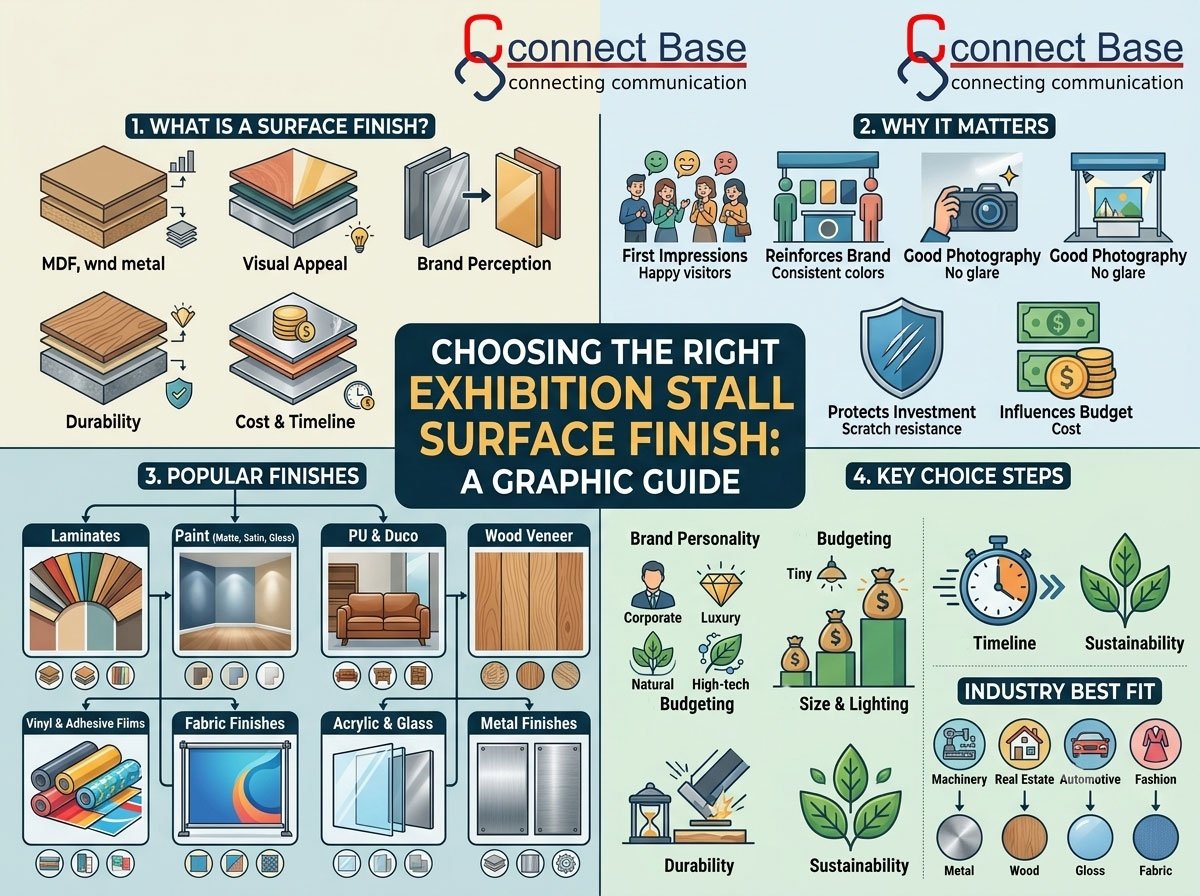
What Is a Surface Finish in Exhibition Stall Design?
A surface finish is the outer layer applied to the structural components of your stall, including walls, counters, flooring, display units, pillars, ceilings and signage panels. The base structure is usually MDF, plywood, aluminium or steel. The finish is what turns that raw material into a polished, branded environment.
Finishes affect four things:
- Visual appeal: colour, gloss and texture set the mood.
- Brand perception: matte black reads differently from warm wood or bright gloss.
- Durability: a finish must survive setup, heavy footfall and dismantling.
- Cost and timeline: some finishes are quick and cheap, others need skilled labour and curing time.
Because finishing is closely tied to build quality, it works best when planned alongside your exhibition stall designing process rather than as an afterthought.
Why the Right Surface Finish Matters
1. It shapes first impressions. Visitors form opinions quickly. Clean edges, consistent colour and a refined texture signal that your company pays attention to detail.
2. It reinforces your brand identity. Your logo and brand colours should look exactly as intended. A finish that shifts or dulls your brand colour weakens recognition.
3. It affects how your stall photographs. Exhibitions generate a lot of social media content. Highly reflective finishes can cause glare in photos, while matte or satin finishes usually photograph well under mixed lighting.
4. It protects your investment. Exhibition stalls are handled roughly. A scratch-resistant, easy-to-clean finish keeps the stall looking fresh through a four-day show, and through reuse if you plan to.
5. It influences budget. Finishing can represent a meaningful share of fabrication cost. Choosing wisely lets you spend where visitors look most and save where they don’t.
Popular Surface Finishes for Exhibition Stalls
1. Laminates (Decorative and High-Pressure)
Laminates are among the most widely used finishes in stall fabrication. They come in solid colours, wood grains, stone looks and metallic effects.
Pros:
- Huge range of colours and textures
- Scratch and moisture resistant
- Easy to clean and cost-effective
- Consistent look across large surfaces
Cons:
- Visible seams on very large panels if not planned well
- Limited ability to create curved surfaces (needs special laminates)
Best for: counters, reception desks, display units and wall panels in medium-budget stalls.
2. Paint Finishes (Matte, Satin, Gloss)
Paint offers unlimited colour matching, making it ideal when your brand palette is strict.
- Matte paint gives a modern, understated, premium look and hides minor surface flaws.
- Satin or semi-gloss adds a soft sheen and is easier to wipe clean.
- High-gloss paint creates a bold, reflective, luxury effect but shows fingerprints and imperfections.
Pros: exact brand colour matching, works on curves, easy touch-ups.
Cons: needs skilled application and drying time, and can chip at edges if handled roughly.
Best for: feature walls, curved elements, logos and brand-colour backdrops.
3. PU (Polyurethane) and Duco Finishes
PU and Duco give a smooth, glass-like or rich, deep-coloured finish, often seen in premium stalls and showrooms.
Pros: superior smoothness, premium appearance, strong protective layer.
Cons: higher cost, longer preparation and curing time, and requires experienced finishers.
Best for: luxury brands, jewellery, automotive, real estate and lifestyle exhibitors where the finish is part of the story.
4. Wood Veneer and Natural Wood Finishes
Real wood veneer brings warmth and authenticity. It suits brands that want to communicate craftsmanship, sustainability or heritage.
Pros: natural, upscale look; can be polished or stained; feels tactile.
Cons: costlier than laminate, sensitive to moisture and scratches, and needs careful handling.
Best for: furniture, handicrafts, organic products, hospitality and interior design brands.
5. Vinyl and Adhesive Films
Vinyl films are versatile, fast and budget-friendly. They come in printed graphics, textures, wood grains, metallic looks and even brushed-steel effects.
Pros: quick to install, large design flexibility, easy to replace between shows, ideal for tight timelines.
Cons: edges can lift if applied poorly, and cheaper films can look flat or wrinkle.
Best for: short-lead-time projects, graphic-heavy walls and stalls designed for frequent reuse.
6. Fabric and Tensioned Fabric Finishes
Stretch fabric systems create smooth, seamless, lightweight surfaces with sharp printed graphics. They are increasingly popular in modular systems.
Pros: lightweight, easy to transport, vibrant printing, crease-free look, washable.
Cons: less rigid feel, can show marks if handled badly.
Best for: hanging structures, wall backdrops, modular stalls and brands that exhibit at multiple events.
7. Acrylic, Glass and Mirror Finishes
Transparent and reflective surfaces add depth and modernity, and let you show products through the surface.
Pros: premium, contemporary and light-enhancing.
Cons: fragile, shows fingerprints, and needs careful safety handling.
Best for: tech, electronics, cosmetics and product showcases.
8. Metal and Metallic Finishes
Brushed steel, powder-coated metal and metallic paint deliver an industrial, high-tech feel.
Pros: strong, durable, modern.
Cons: heavier, more expensive, and reflective surfaces can create glare.
Best for: engineering, machinery, automation and manufacturing exhibitors.
9. Flooring Finishes: Carpet, Vinyl, Wooden and Raised Platforms
Flooring is part of the finish story too. Carpet adds comfort and acoustic softness, vinyl flooring offers a clean and easy-care look, and raised wooden platforms give a premium, defined space.
How to Choose the Right Surface Finish: A Step-by-Step Framework
Step 1: Start With Your Brand Personality
Ask what feeling you want visitors to have.
- Corporate and trustworthy: matte laminates, satin paints, clean white or neutral tones
- Luxury and exclusive: PU or Duco, gloss, metallic accents, mirror or glass
- Natural and sustainable: wood veneer, textured laminates, earthy tones
- Youthful and energetic: bold colours, printed vinyl, mixed textures
- Technical and innovative: brushed metal, dark matte, LED-integrated surfaces
Your finish should feel like an extension of your brand, not a random material choice.
Step 2: Set a Realistic Budget
Finishes vary widely in cost. A useful approach is to spend more on high-visibility zones (the reception counter, main branding wall, product displays) and choose economical finishes for side and back areas.
- Budget-friendly: vinyl films, standard laminates, basic paint
- Mid-range: premium laminates, textured finishes, fabric systems
- Premium: PU or Duco, wood veneer, glass, metal cladding
Discuss your budget early with your exhibition stall fabrication partner so the finish is built into the plan and not squeezed in at the end.
Step 3: Consider Stall Size and Layout
A small 9 sqm stall benefits from light, reflective finishes that make the space feel larger. Large island stalls can carry deeper, bolder finishes because there is room to balance them. Multi-level or double-decker stalls need finishes that are strong and consistent across structures.
Step 4: Think About Lighting
Lighting changes how every finish looks.
- Glossy surfaces reflect spotlights and can create glare.
- Matte surfaces absorb light and keep colours steady.
- Warm lighting flatters wood; cool lighting suits metal and white finishes.
Ask to see finish samples under lighting similar to the exhibition hall. Many designers use 3D stall design visualisation to preview how colours, textures and lighting interact before anything is built.
Step 5: Match the Finish to Your Products
Your finish should support the product, not compete with it. A bright, busy surface can make delicate products look lost, while a neutral backdrop makes colourful products pop. Heavy machinery looks natural against industrial finishes, while cosmetics or electronics often shine against sleek, minimal ones.
Step 6: Plan for Durability and Handling
Ask yourself:
- Will the stall be reused at other exhibitions?
- Will there be heavy visitor traffic or food and drink around counters?
- How much transport and re-assembly is involved?
For reusable stalls, choose scratch-resistant laminates, powder-coated metal or fabric systems. For single-use stalls, vinyl and paint can deliver a strong look at lower cost.
Step 7: Check the Timeline
Some finishes need more time than others. PU and Duco require careful preparation and drying. Vinyl and fabric can be installed quickly. If your show date is close, tell your designer immediately so the finish choice matches the schedule.
Step 8: Check Venue Rules and Safety
Many exhibition venues have rules on fire safety, materials and structure. Some flammable or non-compliant materials can be restricted. Confirm requirements with the organiser and make sure your fabricator uses compliant materials.
Step 9: Think About Sustainability
More exhibitors now prefer eco-friendly choices. Options include low-VOC paints, FSC-certified wood, recyclable fabrics, reusable modular systems and reduced single-use vinyl. A sustainable finish can also become part of your brand story.
Quick Comparison Table
| Finish | Look | Durability | Cost | Best For |
|---|---|---|---|---|
| Laminate | Versatile, clean | High | Low–Medium | Counters, walls |
| Paint | Custom colours | Medium | Low–Medium | Feature walls, curves |
| PU / Duco | Premium, smooth | High | High | Luxury stalls |
| Wood veneer | Warm, natural | Medium | Medium–High | Lifestyle, furniture |
| Vinyl film | Flexible, graphic | Medium | Low | Fast, budget builds |
| Fabric | Seamless, light | Medium | Medium | Modular, reusable |
| Glass / acrylic | Modern, sleek | Low–Medium | High | Tech, cosmetics |
| Metal | Industrial, strong | High | High | Engineering, machinery |
Common Mistakes to Avoid
- Choosing by appearance alone. A beautiful sample may not survive a busy show.
- Ignoring lighting. A finish that looks great in the showroom may glare in the hall.
- Too many textures and colours. Two or three complementary finishes usually look more professional than six competing ones.
- Skipping samples. Always approve physical samples, not only digital renders.
- Leaving finishing to the last minute. Rushed finishing leads to uneven paint, bubbles in vinyl and poor edges.
- Neglecting edges and joints. Clean joinery and edge finishing separate premium stalls from average ones.
- Forgetting maintenance. Keep touch-up paint, cleaning cloths and spare films ready during the event.
Finish Recommendations by Industry
- Engineering and manufacturing: metal accents, dark matte laminates, clean white walls
- Real estate: warm woods, PU finishes, soft lighting
- Automotive: gloss surfaces, metallic elements, sleek flooring
- Textiles and fashion: fabric-based finishes, light backdrops, mirror accents
- Food and beverage: easy-clean laminates, bright graphics, durable counters
- Technology and electronics: minimal white, glass, LED-integrated panels
- Education and services: friendly colours, printed graphics, simple laminates
Expert Tips for a Standout Stall
- Use a hero finish in one area, such as a wood-textured feature wall or a gloss logo panel, and keep the rest simple.
- Blend texture with light, so LED strips highlight grain, pattern or relief.
- Keep brand colours accurate with physical colour matching.
- Use contrast so your logo and key messaging stand out.
- Think 360 degrees, because finishes on the sides and top matter in open-format stalls.
- Inspect on-site before the show opens and fix small damage immediately.
Related Reading
Planning for an upcoming show? These posts may help:
- Engitech Expo Ahmedabad 2026: Stall Design Guide
- India Industrial Fair – Udyam 2026: Exhibition Stall Ideas
- Add another related blog post title here
How Connectbase Communications Can Help
Choosing the right surface finish is easier when design, material knowledge and fabrication skill work together. Connectbase Communications is an exhibition stall design company that helps brands build stalls that attract visitors and reflect their identity.
- Exhibition Stall Designing: creative concepts that match your brand, budget and space.
- Exhibition 3D Stall Designing: realistic 3D previews so you can see colours, textures and finishes before construction begins.
- Exhibition Stall Fabrications: quality fabrication with clean finishing, sturdy structure and on-time setup.
Whether you need a compact stall or a large custom build, our team can suggest finishes that give you maximum impact for your investment.
Ready to plan your next exhibition stall?
Visit www.connectbasecommunications.com or email us at bhavesh.connectbase@gmail.com for a free consultation.
Frequently Asked Questions
1. Which surface finish is best for an exhibition stall?
There is no single best option. Laminates suit most budgets, PU or Duco suits premium stalls, vinyl suits quick builds, and fabric suits reusable modular systems. The right choice depends on brand, budget, timeline and products.
2. Is matte or glossy better for a stall?
Matte finishes look modern, hide flaws and photograph well. Glossy finishes feel luxurious but show fingerprints and can cause glare under spotlights. Many stalls combine matte walls with gloss accents.
3. What is the most budget-friendly finish?
Vinyl films, standard laminates and basic paint are the most economical, and they can still look professional when applied cleanly.
4. Can I reuse my stall finishes at another exhibition?
Yes, if you choose durable options like quality laminates, powder-coated metal or fabric systems, and plan for careful transport and storage.
5. How early should I decide on the finish?
Ideally during the design stage, several weeks before the show, so materials, samples and timelines can be confirmed without rushing.
6. Does the finish affect visitor engagement?
Yes. Texture, colour and lighting influence how inviting a stall feels, and visitors tend to spend more time in spaces that feel well designed and comfortable.
Final Thoughts
The right surface finish is a strategic decision that affects how your brand is perceived, how your stall performs across the show and how well your budget is used. Start with your brand personality, be realistic about cost, test finishes under real lighting, and work with a fabricator who pays attention to detail.
Get the finish right and your stall will look polished, feel premium and stay in visitors’ memory long after the show ends.
