
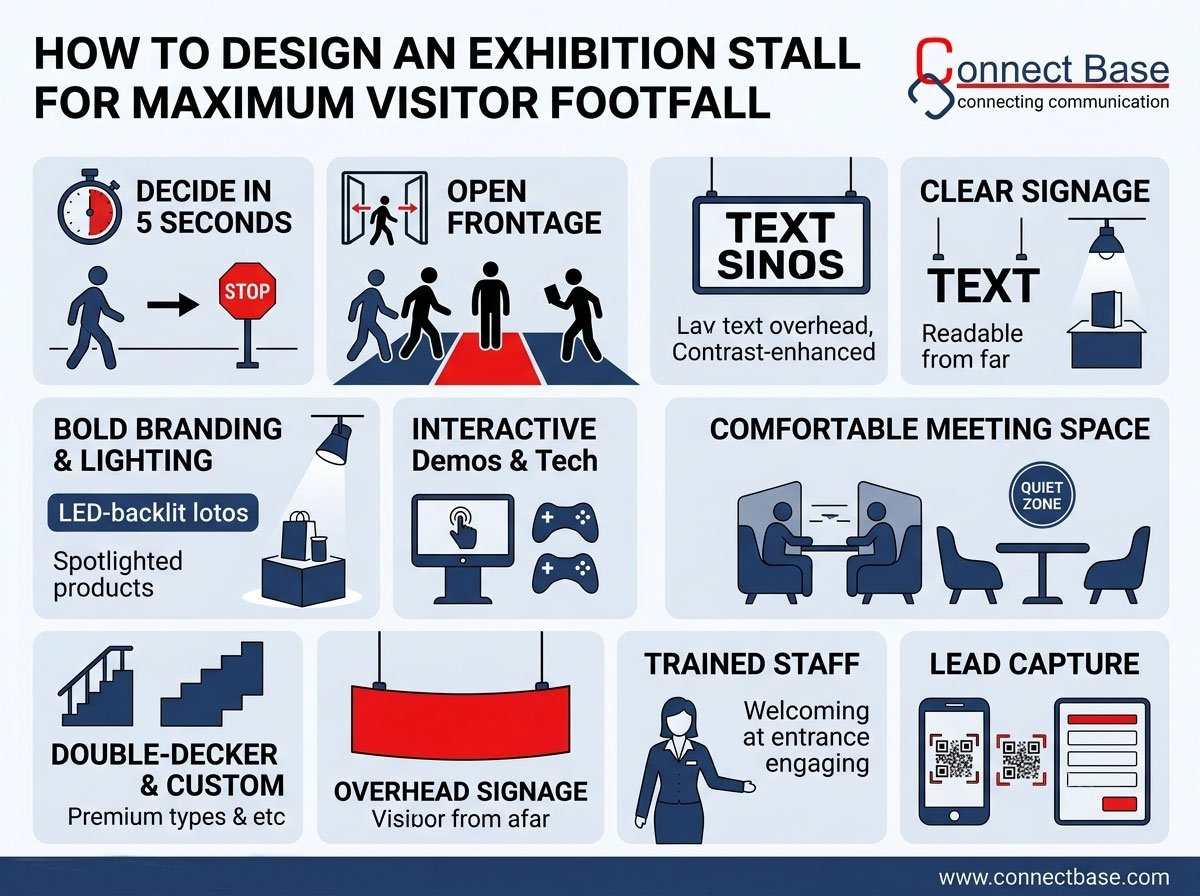
Every exhibitor walks into a trade show with the same goal: get noticed, get visitors to stop, and turn conversations into leads. But with dozens (sometimes hundreds) of competing stalls on the same exhibition floor, simply having a booth isn’t enough. The difference between a stall that pulls in crowds and one that gets walked past almost always comes down to design strategy.
At Connectbase Communications, we’ve designed and built exhibition stalls across industries for years, and we’ve seen firsthand what separates high-footfall stalls from the ones that blend into the background. In this guide, we’ll break down the exact design principles, layout techniques, and psychological triggers that drive visitors toward your stall — and keep them there long enough to convert.
Why Exhibition Stall Design Directly Impacts Footfall
Visitor footfall isn’t random. Studies on trade show behavior consistently show that attendees make a decision to approach or avoid a stall within the first 3 to 5 seconds of seeing it. That decision is driven almost entirely by visual design — not by what your brand does, not by your product specs, but by how inviting, clear, and professional your stall looks from a distance.
This means your exhibition stall design isn’t just a branding exercise. It’s a conversion tool that starts working before a visitor even reaches your booth. Every element — from the height of your signage to the color of your flooring — either pulls people in or pushes them toward a competitor’s stall.
1. Start With a Strategic Floor Plan
Before choosing colors or graphics, the physical layout of your stall needs to be planned around visitor movement.
Key layout principles:
- Open frontage: Avoid walls or tall counters at the entrance. An open, welcoming front increases the likelihood of visitors stepping in.
- Clear sightlines: Visitors should be able to see your brand name, key message, and product zone from at least 20-30 feet away.
- Logical visitor flow: Design a path that guides visitors from an eye-catching entry point, through product or service displays, and toward a meeting or discussion zone — without feeling like a maze.
- Avoid clutter at entry points: Keep the first few feet of your stall visually light. Overcrowding this zone creates a psychological barrier that discourages people from entering.
If you’re exhibiting in a custom exhibition stall, this is where working with an experienced exhibition stall design and build team pays off — they can model footfall patterns specific to your hall layout and booth position.
2. Design for the 5-Second Rule
As mentioned, most visitors decide whether to engage with a stall within seconds. Your design needs to communicate three things almost instantly:
- Who you are (brand identity)
- What you do (core value proposition)
- Why it matters to them (a benefit-driven message, not a slogan)
Use large, legible signage above eye level so it’s visible even from across a crowded aisle. Avoid dense paragraphs of text — a strong headline and a short supporting line will always outperform detailed copy on stall graphics. Save the details for your brochures, digital screens, or sales team conversations.
3. Use Color and Lighting to Draw the Eye
Color psychology plays a bigger role in exhibition design than most exhibitors realize.
- Bold, brand-consistent colors stand out better in a hall full of neutral or white stalls.
- Contrast matters more than brightness — a well-contrasted color scheme is more noticeable than an overly bright one that blends into the general noise of the exhibition floor.
- Lighting should highlight, not just illuminate. Spotlighting key products, using LED accent lighting on your logo wall, or backlighting graphics creates depth and draws attention from a distance.
Stalls that rely only on standard overhead exhibition hall lighting often look flat and forgettable. Strategic lighting design is one of the most cost-effective upgrades for increasing footfall.
4. Make Interactivity Part of the Design
Static displays are easy to walk past. Interactive elements give visitors a reason to stop and engage.
Some proven interactive design elements include:
- Touchscreen product demos or digital catalogs
- Live product demonstrations at scheduled intervals
- Gamified elements like spin-the-wheel or quiz stations tied to lead capture
- AR/VR experiences for product visualization
- Charging stations or free Wi-Fi zones (visitors linger longer when they have a reason to)
If your industry allows for it, consider integrating a small product demo zone into your stall design — even simple, hands-on demonstrations dramatically increase dwell time, which correlates directly with higher lead conversion.
5. Prioritize Comfortable, Functional Meeting Spaces
Footfall is only valuable if visitors stay long enough for a real conversation. Many exhibitors overinvest in the visual “wow factor” of their stall and underinvest in functional meeting areas.
Design considerations:
- Include semi-private seating or discussion pods for serious inquiries
- Keep meeting zones separate from high-traffic walking paths
- Ensure adequate lighting and comfortable furniture — visitors judge your professionalism based on these details
- Provide charging points or refreshment counters near seating areas to encourage longer stays
A well-designed exhibition stand balances the need to attract crowds with the need to hold meaningful, uninterrupted conversations once they arrive.
6. Choose the Right Stall Type for Your Goals
Not every exhibition calls for the same stall format. Your choice of stall type significantly influences both design flexibility and footfall potential.
- Custom-built stalls: Best for large exhibitors wanting a fully branded, immersive experience. Offers maximum design freedom.
- Modular exhibition stalls: Cost-effective and reusable across multiple shows, with reasonable design flexibility.
- Portable exhibition stands: Ideal for smaller budgets or frequent exhibitors, though with more limited design scope.
- Double-decker stalls: Excellent for maximizing visual presence and floor space in large exhibition halls, often used by brands wanting a dominant presence on the show floor.
Choosing the right format depends on your budget, exhibition frequency, and brand goals. Our exhibition stand design services cover custom, modular, and portable formats, tailored to what will actually perform best on your specific show floor.
7. Leverage Digital Signage and Motion
Movement catches the eye far more effectively than static visuals. Digital LED screens, motion graphics, or rotating product displays consistently outperform static banners in pulling visitor attention across a crowded exhibition hall.
If budget allows, incorporate:
- LED video walls for brand storytelling
- Rotating product pedestals
- Motion-sensor triggered lighting or graphics
Even a single well-placed digital screen playing a 30-second brand video on loop can noticeably increase the number of visitors who pause at your stall.
8. Don’t Underestimate Flooring and Overhead Branding
Two often-overlooked design elements that significantly affect footfall:
- Flooring: A distinct flooring design or color instantly defines your stall’s boundary and creates a sense of a designed “destination” rather than an open walkway. It also subtly signals to visitors where your brand space begins.
- Overhead branding (hanging banners/structures): In large exhibition halls, overhead signage is often the only visual element visible from across the venue. It’s one of the highest-ROI design investments for driving footfall from a distance.
9. Train Your Staff to Match the Design Intent
Even the best-designed stall underperforms if the team inside it doesn’t match the energy of the space. Staff should be positioned at the open frontage (not hidden behind counters), actively engaging passersby rather than waiting for them to approach. Design and staffing strategy should work together — a stall built for interactivity needs staff trained to demonstrate and engage, not just hand out brochures.
10. Plan for Post-Show ROI From the Design Stage
Footfall is a means to an end — lead generation and brand recall. Build lead-capture points into your design (digital forms, QR codes on signage, or staffed registration counters) so every visitor who engages leaves a trace. A stall that attracts footfall but has no structured way to capture visitor information wastes much of its design investment.
Final Thoughts
Maximizing visitor footfall at an exhibition isn’t about luck or having the biggest budget on the show floor — it’s about deliberate, strategic design decisions made well before the event. From floor planning and lighting to interactivity and staff positioning, every element should work together to attract attention, invite engagement, and convert conversations into business outcomes.
At Connectbase Communications, we specialize in designing and building exhibition stalls that are engineered for exactly this — footfall, engagement, and measurable ROI. Whether you need a fully custom stall, a modular design for multiple shows, or a portable stand for smaller events, our team handles the strategy, design, and execution end-to-end.
Ready to design a stall that stands out on the show floor? Get in touch with us at bhavesh.connectbase@gmail.com or visit www.connectbasecommunications.com to start planning your next exhibition stall.
Explore Our Related Services
- Custom Exhibition Stall Design
- Modular Exhibition Stands
- Portable Exhibition Stands
- Double-Decker Exhibition Stalls
- Exhibition Stall Fabrication & Execution
