
September 22, 2026
connectc1
Introduction
Choosing the right exhibition stall layout is one of the most important decisions you’ll make before any trade show. The layout you pick doesn’t just define how your booth looks — it determines your visitor footfall, brand visibility, budget, and ultimately, the return on investment from the entire event.
Exhibition organizers typically offer three primary stall positions: open-side (inline) stalls, corner stalls, and island stalls. Each comes with its own advantages, limitations, and ideal use cases depending on your budget, brand goals, and the size of your exhibit.
In this guide, we’ll break down each layout in detail, compare their pros and cons, and help you decide which one is the best fit for your next exhibition. As a leading exhibition stall design company, Connectbase Communications has designed and executed hundreds of stalls across all three formats — so this comparison is based on real project experience, not just theory.
What Is an Open-Side (Inline) Stall?
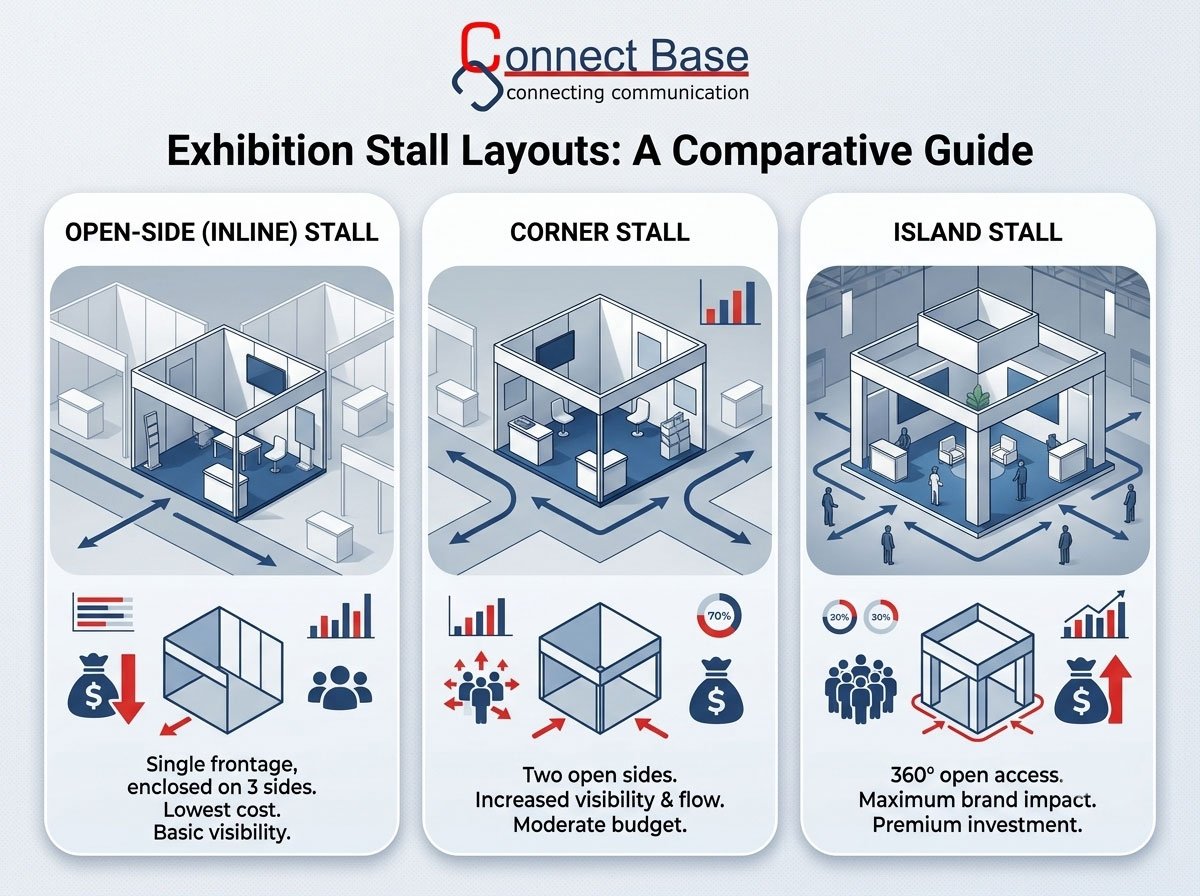
An open-side stall, sometimes called an inline or in-line booth, is a stall with only one side open to the aisle, while the remaining three sides are enclosed by walls shared with neighboring exhibitors. This is the most common and most economical stall format offered at exhibitions.
Key Features of Open-Side Stalls
- Single frontage facing the aisle
- Shared side and back walls with neighboring stalls
- Typically smaller footprint (9 sqm to 18 sqm is common)
- Lower rental cost per square meter compared to corner or island stalls
Advantages
- Budget-Friendly — Since open-side stalls are the standard offering at most venues, they’re priced lower than premium positions, making them ideal for startups and small-to-mid-sized businesses.
- Simpler Design and Faster Build — With only one open face, the design and fabrication process is quicker, and setup/dismantling timelines are shorter.
- Good for Product-Focused Brands — If your goal is to showcase a specific product line rather than create an immersive brand experience, an open-side stall gets the job done efficiently.
- Easier Logistics — Lower material requirements mean easier transportation and storage, especially useful for companies exhibiting at multiple shows through the year.
Limitations
- Limited visibility — only one side is visible to walking traffic
- Less flexibility for branding, since three walls are often standard partitions
- Can feel cramped for demonstrations, meetings, or hospitality areas
- Harder to stand out in a row of similar-looking stalls
Best Suited For
Open-side stalls work well for companies attending regional exhibitions, product launches with a narrow catalogue, or first-time exhibitors who want to test the waters before investing in larger formats.
What Is a Corner Stall?
A corner stall is positioned at the intersection of two aisles, giving it two open sides instead of one. This single change dramatically increases visibility and design flexibility compared to an open-side stall.
Key Features of Corner Stalls
- Two sides open to aisle traffic
- One or two walls shared with neighbors
- Moderate footprint, usually 18 sqm to 36 sqm
- Priced at a premium over open-side stalls, but lower than island stalls
Advantages
- Higher Visibility — Being open on two sides means visitors approaching from either aisle can see your branding, increasing footfall organically.
- Better Branding Opportunities — With two open faces, you get more surface area for signage, backlit panels, and hanging structures that catch attention from a distance.
- Improved Flow — Corner stalls naturally create better visitor movement, reducing bottlenecks that are common in narrow inline booths.
- Balanced Investment — You get a noticeable upgrade in prominence without the significant cost jump that comes with a full island stall.
Limitations
- Still has one or two shared walls, limiting full 360-degree branding
- Design needs careful planning to make both open sides work cohesively
- Costs more than open-side stalls, which may not suit very tight budgets
Best Suited For
Corner stalls are a favorite among mid-sized companies, B2B exhibitors, and brands that want stronger visibility without committing to island-stall budgets. They strike a strong balance between cost and impact — which is why they’re one of the most requested formats we design at Connectbase Communications.
What Is an Island Stall?
An island stall is a standalone stand open on all four sides, typically positioned in the middle of the exhibition floor, surrounded by aisles on every side. This is the most premium and impactful stall format available.
Key Features of Island Stalls
- 360-degree open access and visibility
- No shared walls with any neighboring exhibitor
- Larger footprint, often 36 sqm and above
- Highest rental and construction cost among the three formats
Advantages
- Maximum Visibility — Visitors can see and approach your stall from every direction, making it the most attention-grabbing format on the show floor.
- Complete Design Freedom — Since there are no shared walls, you have full creative control — double-deck structures, hanging banners, custom-shaped counters, and immersive brand zones are all possible.
- Room for Multiple Zones — Island stalls comfortably accommodate product displays, meeting areas, hospitality lounges, and demo zones — all within a single stand.
- Strong Brand Statement — For companies looking to establish market leadership or launch flagship products, an island stall makes a bold, unmissable impression.
Limitations
- Significantly higher cost — both in rental space and stall fabrication
- Requires longer lead time for design, approvals, and construction
- Needs a larger marketing and staffing plan to fill the space effectively
- Not cost-efficient for smaller exhibitors with limited product ranges
Best Suited For
Island stalls are ideal for established brands, industry leaders, and companies exhibiting at flagship international exhibitions where making a strong visual statement is a priority. If your goal is to dominate the show floor and create a memorable, immersive experience, this is the format to invest in.
Open-Side vs Corner vs Island: A Quick Comparison
| Feature | Open-Side Stall | Corner Stall | Island Stall |
|---|---|---|---|
| Open Sides | 1 | 2 | 4 |
| Visibility | Low | Medium-High | Maximum |
| Typical Size | 9–18 sqm | 18–36 sqm | 36+ sqm |
| Cost | Lowest | Moderate | Highest |
| Design Flexibility | Limited | Good | Full Freedom |
| Best For | Startups, product launches | Mid-sized B2B brands | Flagship brands, market leaders |
How to Choose the Right Stall Layout for Your Brand
Selecting a layout isn’t just about budget — it’s about aligning your stall format with your exhibition goals. Here are a few questions worth asking before you decide:
- What’s your primary objective? — Lead generation, brand visibility, product launch, or networking each call for different layouts.
- How many products or zones do you need to showcase? — More zones typically require more open space, pointing toward corner or island formats.
- What’s your realistic budget, including design and fabrication? — Don’t just budget for space rental; factor in stall construction, AV, furniture, and staffing.
- How experienced is your team at managing larger stands? — Bigger stalls need more staff and better crowd management planning.
- What are your competitors doing? — If competitors in your category are investing in island stalls, a modest open-side stall may not hold its own on the floor.
At Connectbase Communications, our exhibition stall design and fabrication team works closely with clients during the planning stage to match the right layout with the right objective — rather than pushing a one-size-fits-all solution.
Design Tips for Each Stall Type
For Open-Side Stalls:
Maximize your single open face with a strong, high-contrast frontage. Use backlit signage and a clear focal point near the entry to draw visitors in from the aisle.
For Corner Stalls:
Design both open corners to work together visually — avoid treating them as two separate stalls. A wraparound graphic or a central feature visible from both aisles works particularly well.
For Island Stalls:
Think vertically as well as horizontally. Use double-deck structures, hanging signage, and distinct zones (demo, meeting, hospitality) to make the most of full accessibility. Since there’s no “back wall,” plan sightlines from all four directions.
Why Stall Layout Matters More Than You Think
Many exhibitors focus heavily on stall graphics and giveaways but underestimate how much the underlying layout influences visitor behavior. Studies on trade show engagement consistently show that visibility and accessibility — both directly tied to layout — are among the top factors influencing whether a visitor stops at a stall at all. A brilliantly designed inline stall can still underperform simply because it’s tucked away in a low-traffic row, while a modestly designed corner stall in a high-traffic zone can outperform expectations.
This is why layout selection should happen before design finalization, not after. At Connectbase Communications, we recommend evaluating the floor plan and traffic flow of the exhibition hall as a first step, well before finalizing stall graphics or booth theme.
Conclusion
There’s no universal “best” exhibition stall layout — the right choice depends on your budget, goals, and the scale of your brand presence. Open-side stalls are perfect for cost-conscious exhibitors and first-timers. Corner stalls offer a strong middle ground of visibility and value. Island stalls deliver maximum impact for brands ready to make a bold statement on the show floor.
Whatever format you choose, the real difference comes down to execution — smart design, efficient space planning, and flawless on-site fabrication.
Planning your next exhibition and not sure which stall layout suits your brand? Get in touch with the team at Connectbase Communications for a free consultation. Explore our portfolio of exhibition stall designs or reach out directly at bhavesh.connectbase@gmail.com to discuss your requirements.
