
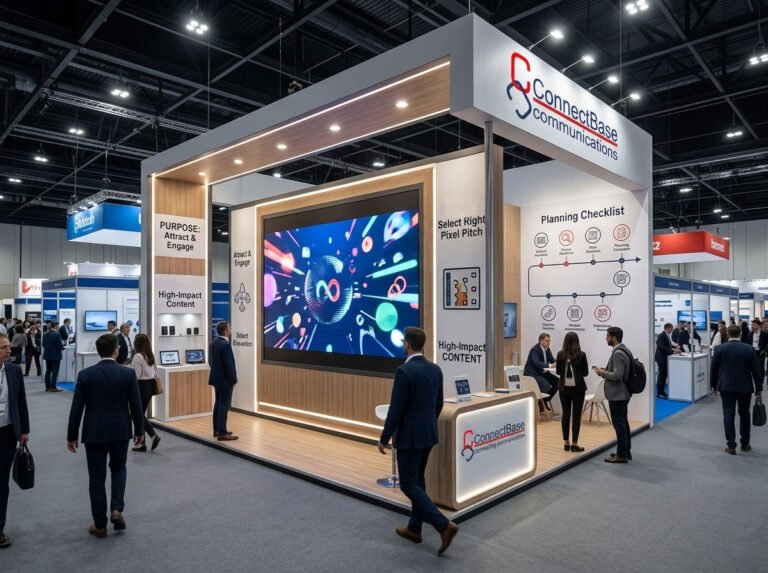
Exhibition Stall Design & Fabrication
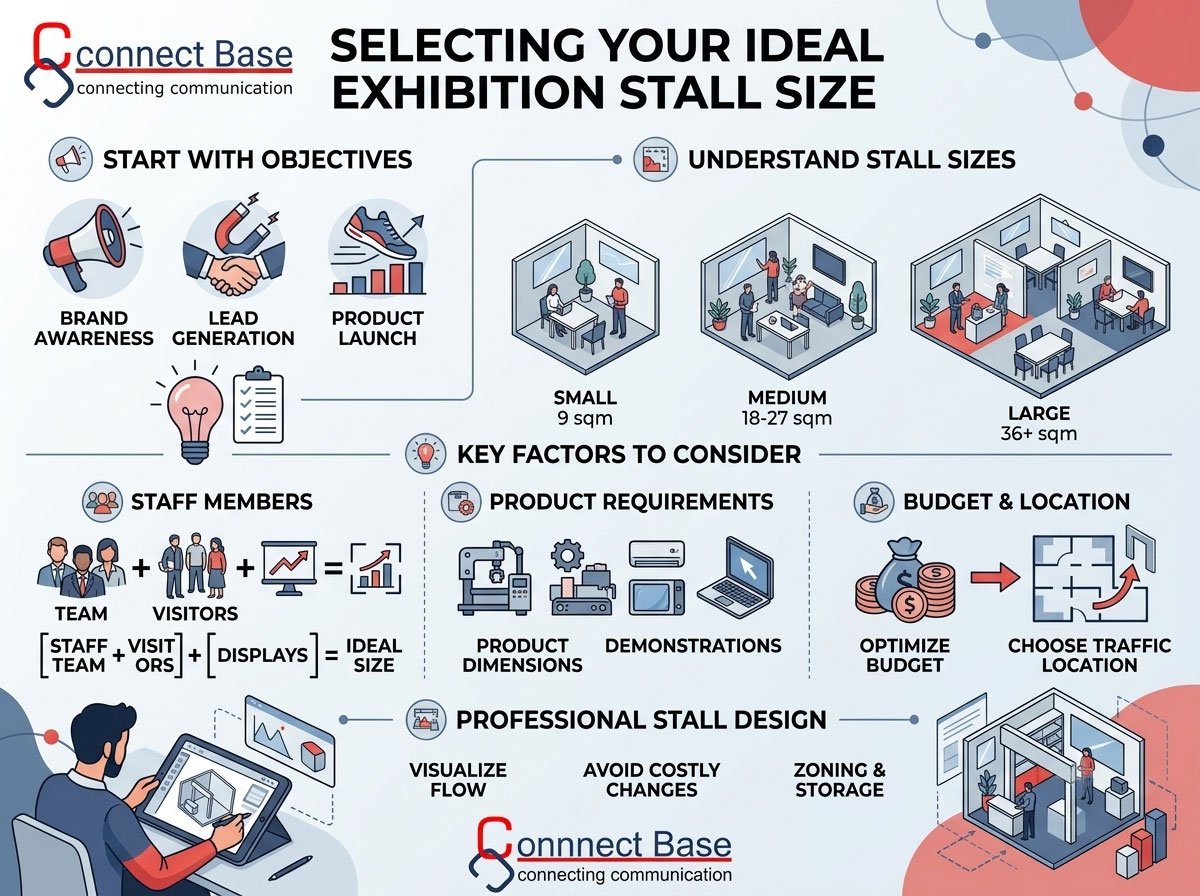
Choosing the right exhibition stall size is one of the most important decisions a business makes before participating in a trade show. Your stall is more than a physical space for displaying products—it is the environment where potential customers discover your brand, interact with your team, experience your products, and decide whether they want to start a business relationship with you.
A stall that is too small can feel crowded and limit your ability to showcase products. A stall that is unnecessarily large can increase your exhibition budget without delivering proportional business value. The ideal exhibition stall size depends on your objectives, product range, visitor expectations, staff requirements, branding strategy, and available budget.
At Connectbase Communications, we provide professional Exhibition Stall Designing, Exhibition 3D Stall Designing, and Exhibition Stall Fabrication Services to help businesses create exhibition spaces that combine visual impact, functionality, and brand communication.
In this guide, we explain how to select the right exhibition stall size for your business and how professional planning can help you get better value from your exhibition investment.
Exhibition space directly affects how visitors experience your brand.
The size of your stall determines how much room you have for:
However, bigger does not automatically mean better.
A well-designed 9-square-metre stall can sometimes attract more attention and generate better visitor engagement than a poorly planned 36-square-metre stall.
The goal is to select a size that supports your exhibition objectives while allowing the space to remain comfortable, attractive, and easy to navigate.
Before choosing a stall size, identify exactly what you want to achieve at the exhibition.
Different businesses require different types of exhibition spaces.
For example, a company launching a new product may need additional demonstration space. A technology company may require screens and interactive zones. A manufacturer may need room for machinery or product samples. A B2B service provider may prioritize private meeting rooms.
Ask yourself:
Your answers will help determine how much space is actually necessary.
Exhibition organizers offer different stall dimensions depending on the event and venue.
Some of the commonly used configurations include:
Small stalls are generally suitable for startups, service companies, and businesses with limited product displays.
They can work effectively when the primary requirement is:
A small stall requires efficient design because every square metre matters.
Medium stalls provide greater flexibility.
Businesses can incorporate:
This category is often suitable for companies that want a balance between visitor interaction and professional presentation.
Large stalls are appropriate for established brands, manufacturers, technology companies, and businesses with extensive product portfolios.
They can accommodate:
However, large spaces need careful planning. Without proper zoning, a large stall can look empty rather than impressive.
Your exhibition team plays an important role in determining the required stall size.
Imagine having ten sales representatives working inside a very small stall. Even with attractive graphics and displays, the space may quickly become uncomfortable.
Visitors need enough room to enter, browse, ask questions, and interact with your team.
Consider:
Number of staff + expected visitors + furniture + displays + circulation space = functional stall requirement
Your stall should provide enough room for your team to work without obstructing visitor movement.
Your product category can significantly influence your stall size.
A company selling compact products may display dozens of products using shelves, counters, display walls, and digital screens.
A company selling industrial machinery may require substantial floor space for only a few products.
Before selecting the stall size, create a rough inventory of everything you want visitors to see.
Consider:
This prevents you from booking a stall and discovering later that your planned displays cannot fit comfortably.
A successful exhibition stall should not feel like a storage area.
Visitor movement needs to be considered from the beginning.
A good layout should make it obvious:
Where should visitors enter?
What should they see first?
Where should they interact with your team?
Where should products be demonstrated?
Where should serious conversations take place?
Where can visitors exit easily?
These questions help create a natural visitor journey.
Professional 3D exhibition stall design is particularly useful at this stage because it allows businesses to visualize furniture placement, display zones, branding, entrances, meeting areas, and visitor circulation before fabrication begins.
Your exhibition stall is one of the largest physical marketing assets your business has at the event.
Stall size affects how much branding you can effectively incorporate.
A larger stall may provide additional opportunities for:
But branding should never become excessive.
Visitors should understand your business quickly.
Your company name, key message, product category, and major value proposition should be visible without overwhelming the design.
Storage is one of the most overlooked elements of exhibition stall planning.
During an exhibition, your team may need space for:
Without dedicated storage, these items may end up underneath tables or behind displays, creating an untidy appearance.
Even a small hidden storage area can make a significant difference to the professionalism of your stall.
When calculating your stall size, always include storage in the floor-plan discussion.
If your business depends heavily on B2B relationships, meetings may be one of the most important functions of your exhibition stall.
A simple open seating area may be sufficient for short conversations.
However, businesses dealing with:
may benefit from semi-private or fully enclosed meeting rooms.
A meeting room requires additional floor space, so it should be included in your initial stall-size calculation.
Instead of simply asking, “How large should my stall be?”, ask:
“How many productive business conversations do I want to conduct at the exhibition?”
That question often gives you a much more practical answer.
Budget is naturally one of the biggest factors when choosing exhibition stall size.
Your exhibition cost may include:
A larger stall generally requires a greater investment.
However, reducing the size solely to save money may not always be the best strategy.
Instead, focus on return on exhibition investment.
A slightly larger, strategically designed stall may generate significantly more qualified conversations than a smaller space that cannot accommodate your products or meeting requirements.
The right question is not simply:
“What is the cheapest stall size?”
It is:
“What stall size can deliver the best business value within my budget?”
The same stall size can perform differently depending on its location within the exhibition hall.
Before finalizing your space, consider:
A stall positioned at a high-traffic intersection may have greater visibility than a similarly sized stall in a low-traffic area.
Therefore, stall size and stall location should be evaluated together.
Businesses sometimes try to fit too many walls and partitions into their exhibition space.
This can make the stall look smaller than it actually is.
An open layout can create:
For smaller exhibition stalls, this becomes particularly important.
Instead of building unnecessary partitions, consider using:
This can help create a spacious appearance without increasing the actual floor area.
One of the smartest ways to determine whether your chosen stall size is appropriate is to create a professional 3D stall design before fabrication.
A 3D design allows you to visualize:
It also allows changes to be made digitally rather than after fabrication has started.
At Connectbase Communications, our exhibition 3D stall designing approach helps businesses transform their ideas into realistic visual concepts before moving toward execution.
This makes it easier to identify space limitations, improve layouts, and create a more practical exhibition environment.
One common mistake is trying to use every available part of the stall.
A stall needs breathing space.
Visitors should be able to stand comfortably, walk around products, and interact with staff without feeling restricted.
Negative space can actually make a stall appear more premium.
Instead of filling every wall and corner, create a hierarchy:
Attraction → Information → Interaction → Conversation → Conversion
This approach gives visitors a reason to enter and a clear path toward engagement.
Your business stage should also influence your stall investment.
Startups may benefit from compact but highly creative stalls focused on:
Growing businesses may require additional product displays, meeting areas, and stronger branding.
A medium-sized stall can provide a useful balance.
Established companies with extensive product portfolios may benefit from larger customized exhibition environments with multiple zones.
The objective should always be to match the space with business requirements—not simply company size.
An exhibition stall should support your marketing strategy before, during, and after the event.
Your design should encourage visitors to:
This means stall size should be connected to your lead-generation strategy.
For example, if you plan to run product demonstrations throughout the exhibition, you need enough space to accommodate people who stop to watch.
If your goal is to collect hundreds of leads, you may need a dedicated reception and lead-capture area.
Avoid these common planning mistakes:
The cheapest option may not provide enough space for your objectives.
Extra space without proper zoning can make your stall appear empty and reduce visitor engagement.
Visible bags, boxes, packaging, and marketing materials can negatively affect your brand image.
Too many products, graphics, tables, and displays can make even a large stall feel small.
Moving directly to fabrication without visualizing the final structure can increase the risk of costly changes.
A stall should be designed around how people move and interact—not just where furniture can fit.
You can start your planning process with four questions:
1. How many staff members will work inside the stall?
2. How many products or services need to be presented?
3. How many meetings or demonstrations will you conduct?
4. What is your realistic exhibition budget?
Then add the physical requirements for:
The resulting space requirement will give your exhibition stall designer a strong starting point.
Selecting the correct stall size is only the first step. Turning that space into an effective brand environment requires professional design and fabrication.
Connectbase Communications provides exhibition stall design and fabrication solutions focused on creating practical, visually appealing, and brand-oriented exhibition spaces.
Our services include:
Our objective is to help businesses make better use of their exhibition space while maintaining a professional appearance and smooth visitor experience.
From the first design concept to the final fabricated stall, proper planning can help reduce unnecessary changes, improve functionality, and create a stronger brand presence.
There is no universal answer to the question, “What is the best exhibition stall size?”
The right size depends on your products, team, visitor expectations, meeting requirements, branding strategy, event objectives, and budget.
A smaller stall can be highly successful when it is intelligently planned. A larger stall can deliver impressive results when every zone has a clear purpose.
The key is to focus on function before size and strategy before decoration.
Before booking your next exhibition space, define your goals, calculate your practical requirements, understand your budget, and visualize the complete layout through professional 3D exhibition stall design.
With the right planning and professional execution, your exhibition stall can become more than a display area—it can become a powerful environment for brand visibility, customer engagement, lead generation, and business growth.
For professional Exhibition Stall Design Services, Exhibition 3D Stall Design Services, and Exhibition Stall Fabrication Services in India, connect with Connectbase Communications.
Website: www.connectbasecommunications.com
Email: bhavesh.connectbase@gmail.com
1. How do I choose the right exhibition stall size?
Choose your stall size according to your products, number of staff, visitor capacity, meeting requirements, display needs, storage requirements, event objectives, and budget.
2. Is a larger exhibition stall always better?
No. A larger stall is useful only when the additional space serves a clear purpose. A well-designed smaller stall can deliver excellent visibility and visitor engagement.
3. Why is 3D exhibition stall design important?
3D design allows you to visualize the proposed stall before fabrication. It helps identify layout problems, improve visitor flow, plan branding, and make design changes before construction.
4. Should I include storage in my exhibition stall design?
Yes. Dedicated storage helps keep marketing materials, personal belongings, packaging, and other items out of visitor sight and maintains a clean professional appearance.
5. How much space should be reserved for meetings?
The requirement depends on the number and type of meetings you expect. Businesses handling important B2B discussions should consider dedicated seating or private meeting areas during the planning stage.
6. Can a small exhibition stall still attract visitors?
Absolutely. Strong branding, creative 3D stall design, effective lighting, open layouts, clear messaging, and interactive displays can make a small stall highly attractive.
7. Why should I work with an exhibition stall design and fabrication company?
A professional exhibition stall company can help integrate design, space planning, fabrication, branding, lighting, furniture, and on-site execution into one coordinated solution.
Planning a stall for an upcoming show? Contact Connectbase Communications or call +91 7600576410 to talk through your requirements.
Keep reading
WhatsApp us
 +91 7600576410