
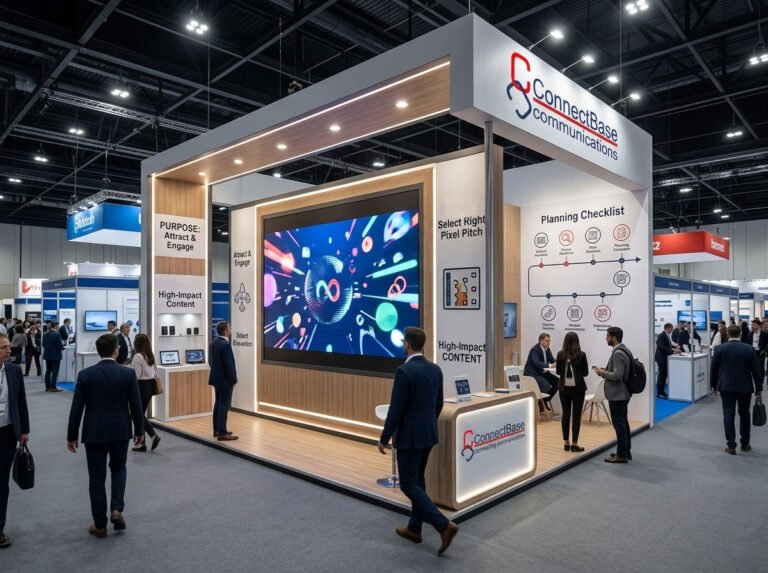
Exhibition Stall Design & Fabrication
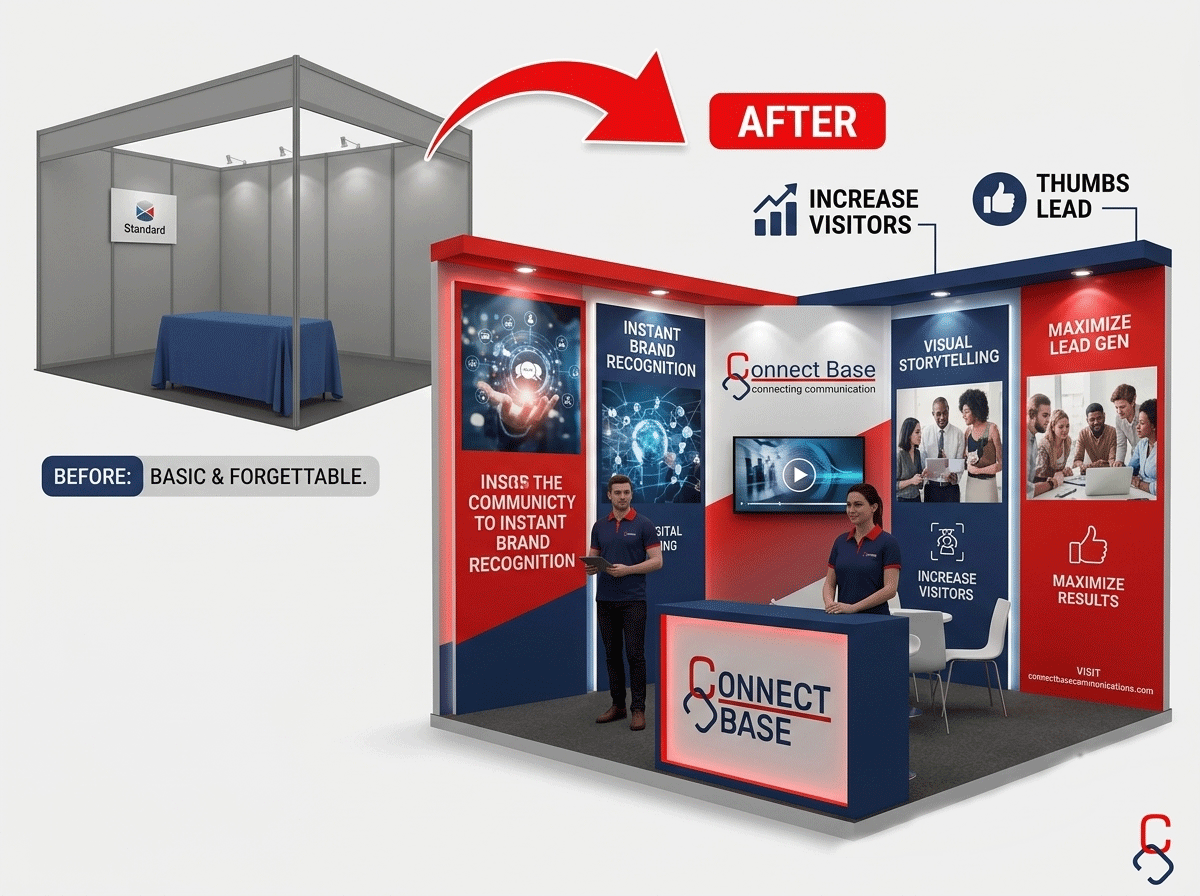
Walk through any trade show floor and you’ll notice something within the first thirty seconds: some stalls stop people in their tracks, while others blend into the background and get walked straight past. The difference is rarely about budget alone — it’s about branding and graphics done right.
An exhibition is one of the few marketing platforms where your brand gets to exist in three-dimensional, physical space, in front of an audience that has actively chosen to be there. Yet many companies still treat their stall as an afterthought — a table, a banner, some brochures — rather than as a strategic branding opportunity. At Connectbase Communications, we’ve seen firsthand how the right combination of branding strategy and graphic execution can completely transform a stall’s performance, turning passive foot traffic into genuine business conversations.
In this article, we’ll explore exactly how branding and graphics work together to elevate an exhibition stall, and what elements make the biggest difference to visitor engagement and lead generation.
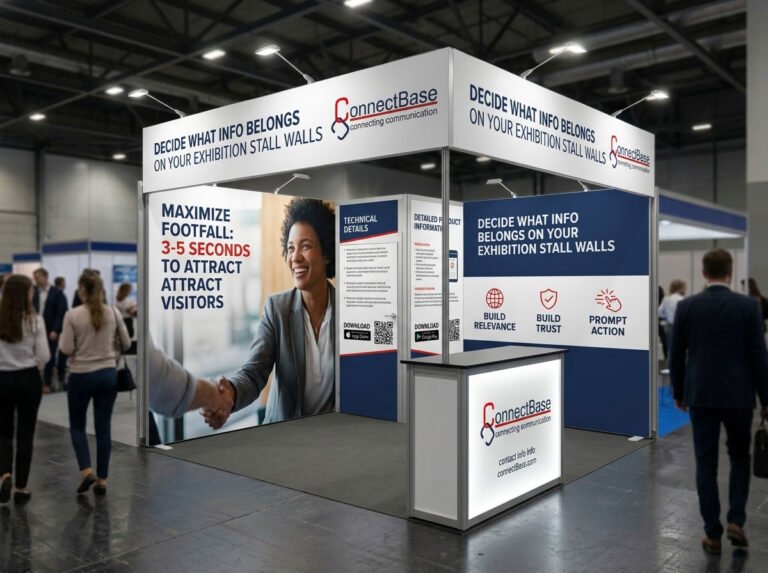
At an exhibition, you typically have between three and five seconds to capture a visitor’s attention as they walk past. Unlike a website, where visitors can read at their own pace, or a print ad, which they can revisit later, an exhibition stall has to communicate who you are, what you do, and why it matters — almost instantly, and from a distance.
This is where branding becomes critical. Your stall’s branding isn’t just decoration — it’s a compressed, high-impact version of your entire brand identity, communicated through color, typography, imagery, and spatial design. Strong branding at an exhibition achieves several things simultaneously:
If branding is the strategy, graphics are the execution — and this is where many exhibition stalls fall short. Generic stock imagery, cluttered messaging, and inconsistent visual language dilute even a strong brand identity. Effective exhibition graphics do a few specific jobs extremely well.
Visitors scanning an exhibition hall aren’t reading paragraphs — they’re absorbing headlines, icons, and imagery in seconds. Graphics need to distill your value proposition into something visually digestible: a bold headline, a striking visual metaphor, or a clear icon-driven explanation of what you offer.
Well-designed exhibition graphics use hierarchy — size, contrast, and placement — to guide a visitor’s eye naturally from the eye-catching hero graphic, to your brand name, to your core message, and finally toward a call to action or product display. Poorly designed stalls often compete for attention within themselves, with too many equally weighted elements fighting for focus.
Every graphic element — backdrop panels, counter wraps, hanging banners, floor graphics, product displays — should feel like part of one unified visual system, not a collection of mismatched print jobs. This cohesion is what separates a professionally branded stall from a stitched-together assembly of marketing collateral.
The best exhibition graphics don’t just display a logo and tagline — they tell a story. Whether it’s showcasing a product in use, illustrating a process, or highlighting customer results, narrative-driven graphics create a more memorable, engaging experience than static, text-heavy panels.
The most effective stalls have one dominant visual element that captures attention from a distance — a striking graphic, a bold color block, or an eye-catching structural feature. Trying to communicate everything at once results in visual noise; a single strong hook does more work than ten competing messages.
Consistency across every touchpoint — backdrop, banners, brochures, staff apparel, even digital screens — reinforces brand memory. Visitors should be able to recognize your stall’s brand identity even with the logo covered, purely from color palette and design language.
Exhibition graphics are viewed from a distance and up close, which means print quality matters enormously. Pixelated images, poor color calibration, or low-resolution graphics undermine even the best design concept. Professional large-format printing, matched to the right substrate and finish, is essential to making graphics look polished under exhibition lighting.
Graphics don’t exist in isolation — they interact with the physical structure and lighting of the stall. Backlit panels, spotlighting on key graphics, and thoughtful structural framing can dramatically elevate how graphics are perceived, adding depth and visual drama that flat, evenly-lit panels can’t achieve.
Where budget allows, integrating digital screens with motion graphics or product videos adds a dynamic layer that static graphics can’t replicate. Movement naturally draws the eye, making digital displays a powerful tool for capturing attention across a crowded hall — provided the content is designed specifically for exhibition viewing distances and durations.
Beyond visual appeal, exhibition graphics need a clear call to action — whether it’s inviting visitors to a demo, a giveaway, or simply to “ask us how.” Beautiful graphics without a clear next step leave engagement on the table.
The physical layout of your stall — where graphics are placed relative to walkways, seating areas, and product displays — shapes how visitors move through the space. Good exhibition design considers not just what graphics say, but where they’re positioned to naturally draw visitors deeper into the stall rather than letting them glance and walk on.
Even companies with strong brand guidelines often make avoidable mistakes at exhibitions:
Avoiding these pitfalls is often as important as getting the creative elements right — a stunning graphic package can still underperform if these fundamentals are overlooked.
The value of strong branding and graphics at exhibitions goes well beyond aesthetics. Companies that invest in cohesive, professionally designed stalls typically see tangible business benefits:
In competitive industries, exhibition presence often shapes first impressions with prospects, partners, and even competitors — making the investment in branding and graphics a strategic decision, not just a design one.
At Connectbase Communications, we treat every exhibition stall as a branding project first and a construction project second. Our process begins with understanding your brand identity, target audience, and exhibition objectives, before translating that strategy into a cohesive visual system — from structural design and lighting to large-format graphics, digital integration, and on-site execution.
We work with businesses across industries to design stalls that don’t just look good in a portfolio photo, but actually perform on the exhibition floor — drawing footfall, communicating clearly, and leaving a lasting brand impression long after the event ends.
Planning your next exhibition? Let’s talk. 🌐 Website: connectbasecommunications.com 📧 Email: bhavesh.connectbase@gmail.com
Q1. How far in advance should I start planning branding and graphics for an exhibition stall? Ideally, branding and graphic design work should begin 6–8 weeks before the event, allowing sufficient time for concept development, revisions, high-quality printing, and structural fabrication without last-minute compromises.
Q2. What’s the difference between exhibition stall design and exhibition stall branding? Stall design typically refers to the physical structure, layout, and construction of the booth, while branding refers to the visual identity elements — colors, messaging, imagery, and graphics — applied to that structure. The two need to work together seamlessly for a stall to be truly effective.
Q3. Can a small stall still have strong branding impact? Absolutely. Strong branding is less about stall size and more about clarity, consistency, and visual hierarchy. Smaller stalls often benefit even more from disciplined design, since there’s less physical space to communicate the message effectively.
Q4. How much should a company budget for exhibition stall graphics? Budgets vary widely based on stall size, materials, and complexity, but companies should generally treat exhibition graphics as a strategic marketing investment rather than a minor line item, given their direct impact on footfall, lead quality, and brand perception at the event.
Connectbase Communications designs and executes exhibition stall branding, graphics, and booth experiences that help brands stand out and perform on the show floor. Visit connectbasecommunications.com or email bhavesh.connectbase@gmail.com to discuss your next exhibition.
Planning a stall for an upcoming show? Contact Connectbase Communications or call +91 7600576410 to talk through your requirements.
Keep reading
WhatsApp us
 +91 7600576410