
September 19, 2026
connectc1
If you’re preparing for your next trade show, you’ve probably come across two terms that get used almost interchangeably: exhibition stall design and exhibition stall fabrication. While they sound similar and are deeply connected, they refer to two very different stages of building your exhibition presence — and understanding the difference can save you time, money, and a lot of last-minute stress.
At Connectbase Communications, we’ve worked with brands across industries to bring exhibition stands to life, and one question we hear constantly from first-time exhibitors is: “Aren’t design and fabrication the same thing?” The short answer is no. The long answer — which explains why getting both right matters so much — is what this blog is all about.
What Is Exhibition Stall Design?
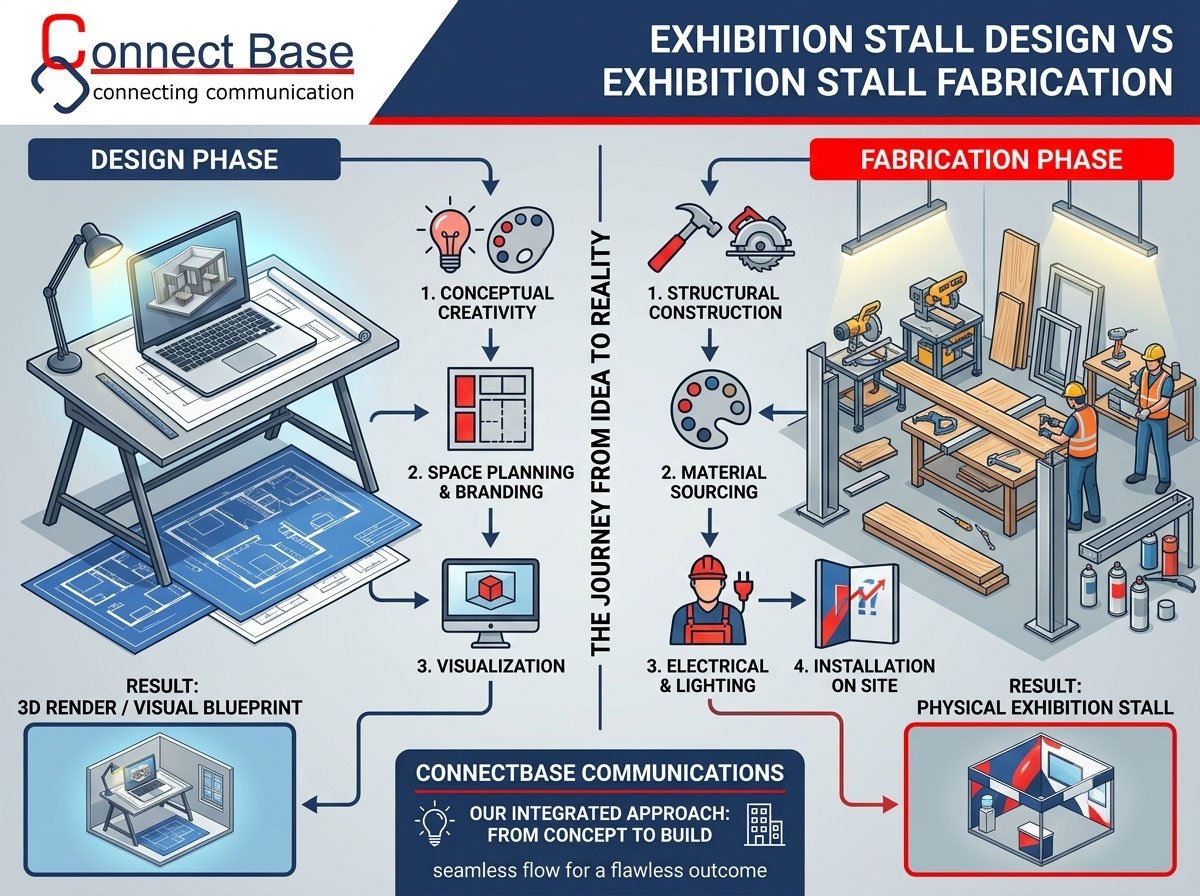
Exhibition stall design is the conceptual and creative phase of building your booth. This is where an idea for your brand’s presence at a trade show is translated into a visual plan — a 2D layout or 3D render that shows exactly how your stall will look, feel, and function.
Stall design typically involves:
- Understanding your brand identity — colors, logo placement, tone, and messaging
- Space planning — how visitors will move through the stall, where the reception desk, meeting areas, product displays, and storage will go
- Visual storytelling — using structure, lighting, graphics, and materials to communicate your brand’s story within seconds
- 3D visualization — creating renders so you can “see” the stall before a single panel is built
- Compliance with exhibition hall guidelines — height restrictions, fire safety norms, and layout rules set by the venue or event organizer
A good exhibition stall designer thinks like both an architect and a marketer. They’re not just making something look attractive — they’re engineering a space that pulls foot traffic in, keeps visitors engaged, and reinforces your brand identity long after the event ends.
This is why exhibition stall design is considered the strategic backbone of your exhibition presence. Every fabrication decision that follows is guided by what’s decided at this stage.
What Is Exhibition Stall Fabrication?
Exhibition stall fabrication is the physical execution phase. This is where the approved design moves off the screen and into the real world — where raw materials like wood, metal, acrylic, vinyl, and fabric are cut, assembled, wired, painted, and installed to match the design blueprint exactly.
Stall fabrication typically involves:
- Structural construction — building the frame, flooring, walls, and overhead structures
- Material sourcing — selecting the right combination of MDF, laminate, fabric, glass, or modular systems based on budget and durability needs
- Electrical and lighting installation — spotlights, backlit panels, LED strips, and power points
- Branding application — printing and mounting graphics, standees, backdrops, and signage
- On-site assembly and installation — transporting stall components to the venue and building the stand within the tight time window most exhibition halls allow
- Quality checks and dismantling — ensuring everything is safe and stable, and later, safely disassembling and removing the stall after the event
Fabrication is where craftsmanship, project management, and logistics come together. A fabrication team needs to solve real-world problems: What if the venue’s ceiling height is lower than expected? What if a material takes longer to source than planned? What if there’s only an 8-hour installation window before the show opens? This is a completely different skill set from design — it’s about precision building, not conceptual creativity.
Exhibition Stall Design vs Fabrication: The Core Differences
| Aspect | Exhibition Stall Design | Exhibition Stall Fabrication |
|---|---|---|
| Phase | Pre-production, conceptual | Production, physical execution |
| Focus | Creativity, branding, layout | Construction, materials, assembly |
| Output | 2D/3D renders, mood boards, floor plans | A physical, standing exhibition stall |
| Skills Required | Design thinking, space planning, branding | Carpentry, engineering, project management |
| Tools Used | Design software (3D modeling, rendering tools) | Fabrication tools, machinery, on-site equipment |
| Timeline | Weeks before the event | Final days leading up to and during setup |
| Key Question Answered | “What should this look like?” | “How do we actually build this?” |
Think of it like building a house. The architect designs the blueprint — where the rooms go, how light enters, what the façade looks like. The construction team then fabricates that vision into a real, livable structure. You wouldn’t want an architect pouring concrete, and you wouldn’t want a construction crew deciding your home’s layout without a plan. Exhibition stalls work exactly the same way.
Why This Distinction Actually Matters for Exhibitors
Many exhibitors assume that once a design is approved, fabrication is just a formality — a mechanical “copy-paste” of the render into real life. In reality, the transition from design to fabrication is where most exhibition budgets and timelines go wrong if not managed properly.
Here’s why understanding the difference is critical:
1. Budgeting Gets More Accurate
A stunning 3D render can sometimes include materials or finishes that are far more expensive to fabricate than the client realizes. Knowing that design and fabrication are separate cost centers helps you ask the right questions upfront: Is this material available locally? What’s the lead time? Is there a more cost-effective alternative that looks just as premium?
2. You Choose the Right Partner
Some vendors are excellent designers but outsource fabrication, leading to communication gaps, delays, and quality inconsistencies between the render and the final stall. Others are strong fabricators but lack in-house design talent, resulting in stalls that are sturdy but forgettable. The best outcomes come from a partner who manages both design and fabrication in-house — ensuring what’s promised on paper is exactly what shows up on the exhibition floor.
3. Timelines Stay Realistic
Design typically takes 1–3 weeks depending on complexity and revisions. Fabrication, especially for custom stalls, requires additional lead time for sourcing materials, building components, and testing everything before it’s shipped to the venue. Exhibitors who understand this timeline avoid the common mistake of finalizing designs too late and leaving fabrication teams scrambling.
4. Quality Control Improves
When design and fabrication are handled by the same team, there’s accountability at every step. Any changes needed during fabrication — because of last-minute booth resizing, an updated product line, or client feedback — can be handled fluidly rather than getting lost in translation between separate vendors.
How Connectbase Communications Bridges Design and Fabrication
At Connectbase Communications, we don’t treat design and fabrication as two separate transactions — we treat them as one continuous process. Our in-house team manages everything from the first concept sketch to the final on-site installation, which means:
- Your design vision is never compromised during fabrication
- Material and cost decisions are made collaboratively during the design phase itself, avoiding surprises later
- Our fabrication team is involved early, flagging any structural or logistical challenges before they become expensive problems
- You get a single point of contact throughout the project instead of juggling multiple vendors
Whether you need a compact 9 sqm stall or a sprawling double-decker exhibition pavilion, our combined design-and-fabrication approach ensures your brand’s presence is not just beautiful on paper, but flawlessly executed on the show floor.
Explore our Exhibition Stall Design services to see how we plan and visualize brand-first exhibition spaces, or check out our Exhibition Stall Fabrication services to understand our end-to-end build and installation process.
Common Myths About Exhibition Stall Design and Fabrication
Myth 1: “If the design looks good, the stall will automatically look good.”
Not necessarily. Poor fabrication — rushed assembly, low-grade materials, or inexperienced on-site teams — can make even the best design look cheap or unfinished in real life.
Myth 2: “Fabrication is just about following instructions.”
Fabrication requires problem-solving on the ground. Venue restrictions, delivery delays, and structural challenges often demand real-time decisions that only experienced fabricators can make without compromising the design intent.
Myth 3: “You can hire separate vendors for design and fabrication to save money.”
This can work, but it often introduces communication gaps, inconsistent quality, and finger-pointing if something goes wrong. Unless both vendors are exceptionally well-coordinated, this route tends to increase risk rather than reduce cost.
Myth 4: “Design takes longer than fabrication.”
In most custom stall projects, it’s the opposite. Fabrication — sourcing, building, transporting, and installing — usually takes considerably longer and requires tighter timeline management than the design phase.
Choosing the Right Exhibition Partner: What to Look For
When evaluating exhibition stall companies, ask these questions to understand whether they can truly deliver on both fronts:
- Do you have an in-house fabrication unit, or do you outsource construction?
- Can I see past projects where the final stall matches the original 3D render?
- What’s your typical timeline from design approval to on-site installation?
- How do you handle last-minute changes during the fabrication stage?
- What materials do you typically use, and are there sustainable or reusable options available?
A partner who can confidently answer all of these — and back it up with a portfolio — is far more likely to deliver a stress-free exhibition experience.
Final Thoughts
Exhibition stall design and exhibition stall fabrication are two sides of the same coin — one imagines the space, the other builds it. Neither can succeed without the other, and the exhibitors who get the best results are the ones who understand this relationship and choose partners capable of excelling at both.
If you’re planning your next trade show and want a team that handles your exhibition journey from the first sketch to the final installation, Connectbase Communications is here to help. Reach out to us at bhavesh.connectbase@gmail.com to discuss your next exhibition stall project.
Related Reads on Our Blog
- How to Choose the Right Exhibition Stall Design for Your Industry
- Top 10 Trends in Exhibition Stand Design for 2026
- Modular vs Custom Exhibition Stalls: Which One Should You Choose?
- A Complete Checklist for Exhibition Stall Installation Day
- How to Budget for Your First Trade Show Booth
Explore Our Services
- Exhibition Stall Design
- Exhibition Stall Fabrication
- Custom Exhibition Stands
- Modular Exhibition Stalls
- Portable Display Solutions
