
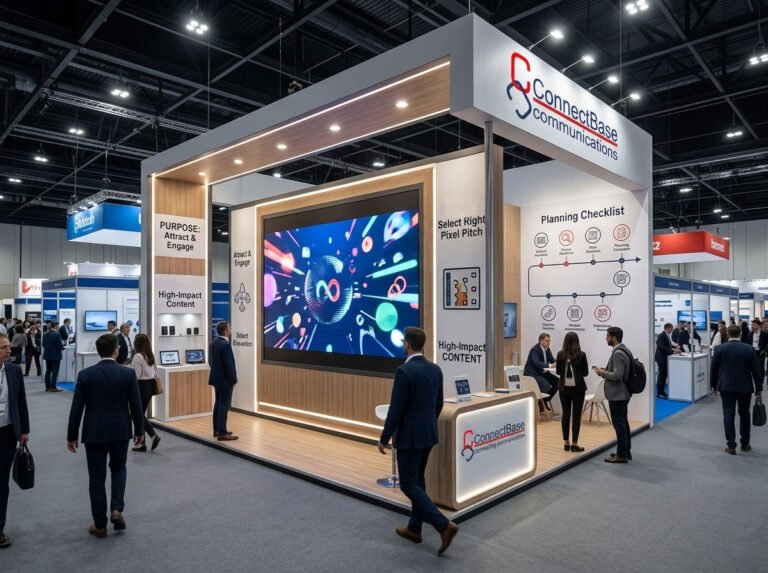
Exhibition Stall Design & Fabrication
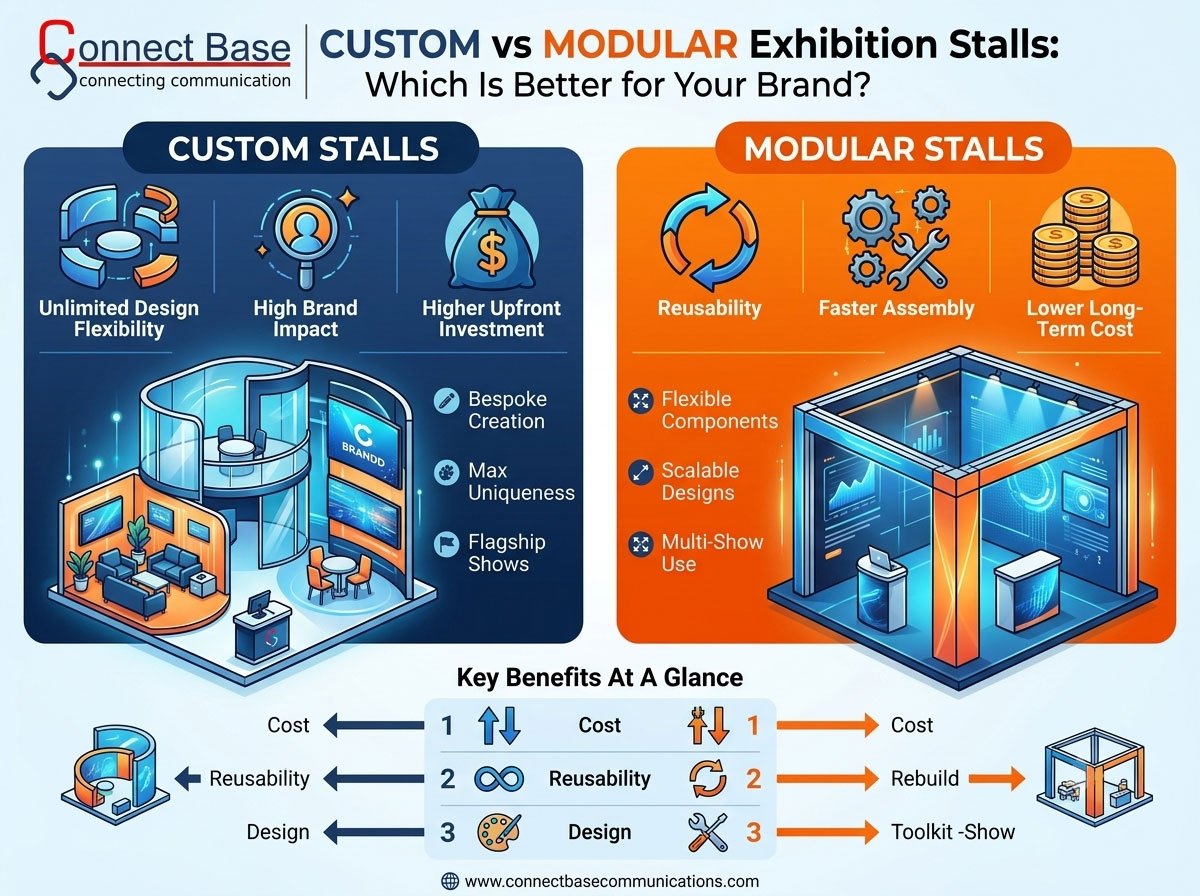
Every exhibitor walking into a trade show floor faces the same question before a single banner is printed or a single panel is ordered: should you go custom or modular? It’s one of the most important decisions in exhibition planning, because your stall isn’t just a structure — it’s the first physical impression your brand makes on a potential client. Get it wrong, and you either overspend on something you didn’t need, or under-deliver on an experience that could have won you the deal.
At Connectbase Communications, we’ve designed and built exhibition stalls for brands across industries, and this is, hands down, the question we hear most often from first-time and seasoned exhibitors alike. In this guide, we’ll break down exactly what custom and modular stalls are, how they compare on cost, flexibility, branding impact, and long-term value, and how to decide which one is right for your next show.
A custom exhibition stall is designed and built from the ground up, specifically for your brand and your event. Every element — the layout, the materials, the lighting, the flooring, the furniture, the color palette, the way visitors move through the space — is planned around your brand identity and your objectives for that particular show.
Custom stalls are typically built by an exhibition stall design company that works with you through a full process: understanding your brand, sketching concepts, creating 3D renders, sourcing materials, fabricating structures, and executing the on-site installation. Nothing is off-the-shelf. If you want a two-story stall with a private meeting lounge upstairs and an interactive product wall downstairs, a custom build makes that possible.
A modular exhibition stall is built using a system of reusable, pre-engineered components — panels, frames, connectors, and fittings — that can be assembled, disassembled, and reconfigured for different booth sizes and different shows. Think of it as a flexible toolkit rather than a one-time structure.
Modern modular systems have come a long way from the flimsy pop-up booths of a decade ago. Today’s modular stalls can look sleek, premium, and highly branded, using aluminum extrusion frames, tension fabric graphics, backlit panels, and modular furniture — all while remaining reusable across multiple events.
| Factor | Custom Stalls | Modular Stalls |
|---|---|---|
| Design Flexibility | Unlimited — built around your exact vision | Flexible within a system’s design library |
| Initial Cost | Higher upfront investment | Lower upfront investment |
| Long-Term Cost (Multiple Shows) | Rebuilt or heavily modified each time | Reusable, so cost per show drops over time |
| Production Timeline | Longer — weeks of design and fabrication | Shorter — faster turnaround |
| Brand Impact | Maximum uniqueness and memorability | Strong, consistent, but less “wow factor” |
| Storage & Logistics | Often single-use or storage-heavy | Compact, stackable, easy to transport |
| Best For | Flagship shows, product launches, big budgets | Recurring exhibitions, multiple cities, tighter budgets |
| Sustainability | Can generate more waste if not reused | More sustainable due to repeated use |
Cost is usually the first thing exhibitors ask about, but it’s worth looking beyond the sticker price.
Custom stalls require investment in design development, unique fabrication, specialized materials, and often a dedicated project management team to oversee production and installation. You’re paying for originality — a structure that exists only for your brand. If you exhibit at one major show a year, or you’re launching a flagship product, this investment can pay for itself many times over in brand recall and lead quality.
Modular stalls spread their cost across multiple uses. The initial system might cost less than a full custom build, and because the components are reusable, your cost per exhibition drops significantly after the second or third show. For brands that exhibit frequently — say, at five or six trade shows a year across different cities — modular systems often make far more financial sense.
A good exhibition stall design company will actually walk you through both cost models before recommending a direction, rather than pushing whichever option is more profitable for them.
This is where the conversation gets interesting, because “better branding” doesn’t always mean “more custom.”
Custom stalls give you complete creative control. If your brand story involves a specific spatial experience — a walkthrough narrative, an immersive product demo zone, a VIP lounge with a very particular aesthetic — only a custom build can deliver that precisely. Visitors remember stalls that don’t look like anything else on the floor, and a striking custom design can genuinely become the talk of the show.
But modular doesn’t mean generic. With the right design partner, modular stalls can be highly branded, visually striking, and instantly recognizable — especially with large-format graphics, backlit walls, and well-thought-out layouts. The difference is that the “wow factor” tends to come from graphics and lighting rather than architectural uniqueness.
The real question to ask isn’t “which looks better in isolation” — it’s “which format best expresses what my brand needs to say at this specific show.”
If your company exhibits at different booth sizes across different events — a 6×6 at one show, a 3×3 at another, a double-decker at a flagship event — modular systems offer real scalability. A well-designed modular kit can be reconfigured to fit multiple footprints without starting from scratch each time.
Custom stalls, by contrast, are built for a specific space. If your booth size changes from show to show, a custom stall either needs significant rework or simply won’t fit — which can mean additional cost and lead time every single time.
This is a major reason many growing brands start with modular systems as they scale their exhibition presence, then invest in a custom build once they’ve identified their flagship, must-impress event of the year.
Trade show timelines are unforgiving. Halls open on schedule regardless of whether your stall is ready.
If you’re working with a tight production window, or if you’re exhibiting internationally and need to minimize freight and labor complexity, modular is often the more practical choice.
Sustainability has become a real consideration for exhibitors, not just a buzzword. Modular stalls, by design, are reused across multiple events, which reduces material waste and the environmental footprint per show. Many modular systems also use lighter materials, reducing shipping emissions.
Custom stalls can still be sustainable if built with reusable substructures and updated graphics for each show, but this requires deliberate planning at the design stage. If sustainability is a brand priority, it’s worth discussing with your stall design partner from day one — regardless of which format you choose.
There’s no universal right answer — only the right answer for your specific goals, budget, and exhibition calendar. Here’s a simple way to think about it:
Choose Custom If:
Choose Modular If:
Consider a Hybrid Approach: Many brands today are choosing a middle path — a modular base structure with custom-branded elements layered on top, such as bespoke reception counters, unique product displays, or custom lighting features. This gives you the flexibility and cost efficiency of modular systems with pockets of custom design where it matters most.
At Connectbase Communications, we specialize in exhibition stall and stand design that’s built around your brand’s real objectives — not a one-size-fits-all template. Whether you need a fully custom flagship stall for a major industry event, a modular system you can deploy across multiple shows, or a hybrid design that blends both, our team handles the full journey: concept, design, fabrication, and on-site execution.
We take the time to understand your brand, your budget, and your exhibition calendar before recommending a direction — because the best stall design is the one that actually works for your business, not just the one that looks good in a portfolio.
If you’re planning your next trade show and weighing custom versus modular, we’d be glad to walk you through both options based on your specific requirements.
Get in touch: 🌐 Website: www.connectbasecommunications.com 📧 Email: bhavesh.connectbase@gmail.com
1. Which is more cost-effective — custom or modular exhibition stalls? Modular stalls are generally more cost-effective over multiple exhibitions because components are reused. Custom stalls have a higher upfront cost but can deliver stronger one-time brand impact for flagship events.
2. Can modular stalls look as premium as custom stalls? Yes. With quality materials, backlit graphics, and thoughtful layout design, modular stalls can look highly premium and are often indistinguishable from custom builds to the average visitor.
3. How far in advance should I plan a custom exhibition stall? For a fully custom build, it’s best to start planning at least 8–12 weeks before the event to allow time for design approval, fabrication, and installation logistics.
4. Can I convert a modular stall design for different booth sizes? Yes, that’s one of the biggest advantages of modular systems — a well-designed modular kit can typically be reconfigured to fit various booth dimensions with minimal additional cost.
5. Is a hybrid stall design a good option for growing brands? Absolutely. A hybrid approach — modular structure with custom branded elements — is popular with growing companies that want flexibility now with room to invest in fully custom builds as their exhibition presence expands.
Connectbase Communications designs and builds exhibition stalls that help brands stand out on the show floor. Reach out at www.connectbasecommunications.com or bhavesh.connectbase@gmail.com to discuss your next stand design project.
Keep reading
WhatsApp us
 +91 7600576410