
September 26, 2026
connectc1
Exhibitions and trade shows remain one of the most powerful platforms for B2B and B2C brands to generate leads, build relationships, and showcase their identity face-to-face. But in a hall filled with hundreds of competing booths, a flat, uninspired stall simply gets lost in the noise. This is where 3D exhibition stall design changes the game — giving brands a fully realized, walk-through preview of their stand before a single panel is fabricated.
If you’re evaluating vendors for your next event, you’ve probably already seen dozens of portfolios claiming “creative” and “innovative” designs. So how do you actually separate a genuinely professional 3D exhibition stall design service from one that just renders a pretty picture? This guide breaks down exactly what to look for — and why it matters for your brand’s ROI at the show.
1. A True 3D Design Process, Not Just a Rendered Image
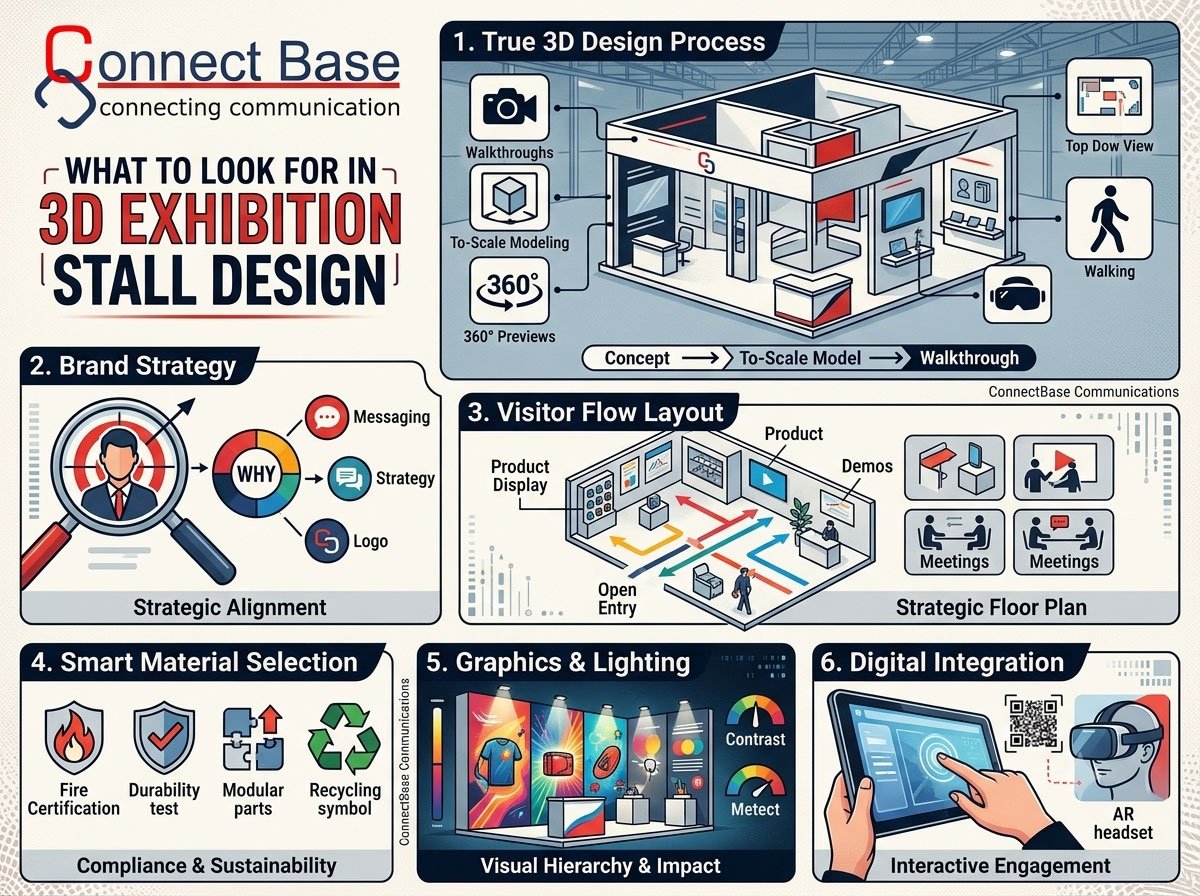
Many vendors label a single flat rendering as “3D design,” but a professional process goes much deeper. A genuine 3D exhibition stall design should include:
- Multiple camera angles and walkthrough views so you can see the stall from every visitor’s perspective — entrance, side aisles, and the back wall.
- To-scale modeling that accounts for real exhibition hall dimensions, ceiling height restrictions, and venue-specific regulations.
- Material and lighting simulation that shows how your stall will actually look under hall lighting, not just studio-rendered light.
- Interactive or 360° previews, increasingly offered by advanced design studios, letting you “walk” your booth digitally before approving it.
If a company can only offer you a single static image with no ability to revise angles or explore the space, that’s a red flag. A strong design partner treats the 3D model as a working blueprint, not a marketing image.
2. Deep Understanding of Your Brand Strategy
A stall isn’t just a structure — it’s a three-dimensional extension of your brand. Before any design work begins, a professional team should be asking about your:
- Target audience and what will draw them in from the aisle
- Key messaging and product hierarchy (what should visitors see first, second, third?)
- Brand color palette, typography, and visual identity guidelines
- Competitive positioning — what nearby exhibitors might be doing
This is precisely the kind of strategic groundwork we follow at Connectbase Communications, where every stall design begins with studying competitor design patterns and market research before a single sketch is made. Without this strategic foundation, even a visually striking stall can fail to communicate the right message to the right visitor.
3. Layout That Prioritizes Visitor Flow
One of the most overlooked aspects of exhibition stand design is traffic flow. A stunning stall with a poor layout can actually repel visitors rather than attract them. Look for a design partner who plans for:
- Open, inviting entry points rather than barriers that make visitors hesitate
- Clear zoning — separate areas for product display, demonstrations, meetings, and casual conversation
- Sightlines that let visitors see key visuals from multiple angles across the hall
- Adequate breathing room so the stall doesn’t feel cramped during peak footfall hours
This is exactly why maintaining strong design aesthetics matters so much for layout and flow — a topic we cover in more depth in our blog post on why it’s important to maintain exhibition stand design aesthetics. A cluttered or confusing stall undermines even the best individual design elements.
4. Smart, Durable Material Selection
3D renders can make almost any material look premium — but a professional design team will be upfront about what materials are realistic for your budget and timeline, and how they’ll actually perform on-site. Ask potential vendors about:
- Whether they’re proposing modular/reusable structures or a custom one-time build
- Fire safety and hall compliance certifications for all materials used
- How materials will hold up under exhibition lighting, foot traffic, and multi-day setups
- Sustainability options, such as recyclable or reusable structural components
A design that photographs beautifully but is fabricated from flimsy or non-compliant materials will cost you more in the long run — in repairs, re-fabrication, or even venue penalties.
5. Thoughtful Use of Graphics, Color, and Lighting
Color and graphics do more heavy lifting in exhibition design than most brands realize — they’re often what draws a visitor’s eye from 20 feet away before they’ve even read your signage. A professional 3D design should demonstrate:
- Strategic color contrast that makes your stall pop against neighboring booths
- Graphic hierarchy that guides the eye from bold hero visuals down to finer product details
- Lighting design that highlights key products, not just generic ambient lighting
We’ve written extensively on this exact subject in our post on the significance of graphics and color choice in exhibition stand design — it’s one of the most impactful (and most under-budgeted) parts of any stall.
6. Integration of Interactive and Digital Elements
Modern trade show audiences expect more than static displays. A forward-thinking design team will recommend where digital and interactive technology can genuinely enhance engagement, such as:
- Touchscreens or tablets for product configurators and catalogs
- LED video walls for dynamic brand storytelling
- AR/VR demo stations for complex or technical products
- QR-code-driven lead capture integrated directly into the stall’s visual design
The key here is integration, not decoration. Technology should be built into the 3D design from the start — not bolted on as an afterthought once the structure is finalized. This is also a growing trend across the industry, one we track in our blog on upcoming trends in the events and exhibition industry.
7. Realistic, Transparent Budgeting
A trustworthy exhibition stall design partner will give you a clear cost breakdown tied directly to the 3D design — covering design fees, fabrication, materials, technology, transport, on-site installation, and dismantling. Be cautious of vendors who:
- Quote an unusually low price with vague inclusions
- Present a beautiful 3D render but push back when asked for itemized costs
- Don’t account for on-site labor, logistics, or contingency costs
Transparent budgeting from the design stage prevents costly surprises later and helps you compare quotes across vendors on an apples-to-apples basis.
8. End-to-End Project Management
3D design is only the starting point — the real test of a professional exhibition partner is whether they can execute that design flawlessly on-site. Look for a company that manages the entire lifecycle:
- Strategy — understanding your goals and market position
- Planning — timelines, permits, and venue coordination
- Build — fabrication and on-site construction
This end-to-end approach — strategy, planning, and build under one roof — is core to how we operate at Connectbase Communications, ensuring nothing gets lost in translation between the design file and the finished stall on the exhibition floor.
9. A Strong, Verifiable Portfolio
Before signing with any exhibition stall design company, review their past work critically:
- Do their previous stalls show variety across industries, not just one repeated template?
- Are there client testimonials or case studies you can verify?
- Have they handled stalls of a similar scale and budget to yours?
- Can they show before-and-after examples — from 3D concept to final built stall?
A design company with 500+ clients across India, like Connectbase Communications, should be able to show a track record of translating 3D concepts into real, functioning exhibition spaces — not just a portfolio of renders that never got built.
10. Post-Event Support and Reusability Planning
Finally, a professional partner thinks beyond the three or four days of the event itself. Ask about:
- Storage and reuse options if you plan to exhibit again
- Teardown and logistics support
- Post-event feedback and ROI reporting
- Refresh or update services for future shows using the same base structure
Planning for reusability from the 3D design stage can significantly reduce costs for brands that exhibit multiple times a year — something worth discussing at the very first design consultation. For a broader planning framework, our guide on planning a successful exhibition walks through this exact process step-by-step.
Final Thoughts
A professional 3D exhibition stall design isn’t just about a visually impressive render — it’s the product of strategic planning, brand alignment, smart material and layout choices, transparent budgeting, and a team capable of executing that vision on the exhibition floor. When evaluating a design partner, look past the pretty pictures and ask about process, portfolio, and post-production support.
At Connectbase Communications, we specialize in end-to-end exhibition stall design and fabrication — from strategy and 3D visualization through to on-ground build. If you’re planning your next exhibition and want a stall that’s designed to convert footfall into real business outcomes, get in touch with us.
Explore more:
- Our stall design and fabrication services: www.connectbasecommunications.com
- Related read: A Guide for Planning a Successful Exhibition
- Related read: Why It’s Important to Maintain Exhibition Stand Design Aesthetics
- Related read: Significance of Graphics and Choice of Color in Exhibition Stand Design
- Related read: Upcoming Trends in the Events & Exhibition Industry
Contact us: bhavesh.connectbase@gmail.com
