MDF vs. Plywood vs. Aluminium for Exhibition Stalls: The Ultimate Material Selection Guide
July 7, 2026Connectbase CommunicationsComments Off on MDF vs. Plywood vs. Aluminium for Exhibition Stalls: The Ultimate Material Selection Guide
When preparing for a trade show, exhibition, or large-scale corporate expo, most of your initial focus naturally goes toward the visual strategy: the layout, colors, lighting, and branding. However, behind every beautiful layout stands a critical structural decision that directly impacts your budget, logistics, safety, and brand image—the choice of core materials.
The physical build of your stall dictates how premium it looks up close, how well it holds up under heavy foot traffic, and how easily it can be transported and assembled within the venue’s strict setup windows.
In the exhibition industry, three materials dominate structural fabrication: Medium-Density Fibreboard (MDF), Plywood, and Aluminium. Each material brings a unique set of structural properties, finishes, and price points to the table.
At Connectbase Communications, we believe that exceptional Exhibition Stall Design Services must walk hand-in-hand with expert Exhibition Stall Fabrication Services. Choosing the wrong material can lead to visible structural seams, sagging walls, or blown budgets, while the right material maximizes your trade show ROI.
This comprehensive guide breaks down the strengths, limitations, and ideal use cases for MDF, Plywood, and Aluminium, helping you make an informed decision for your next exhibition.
1. Medium-Density Fibreboard (MDF)
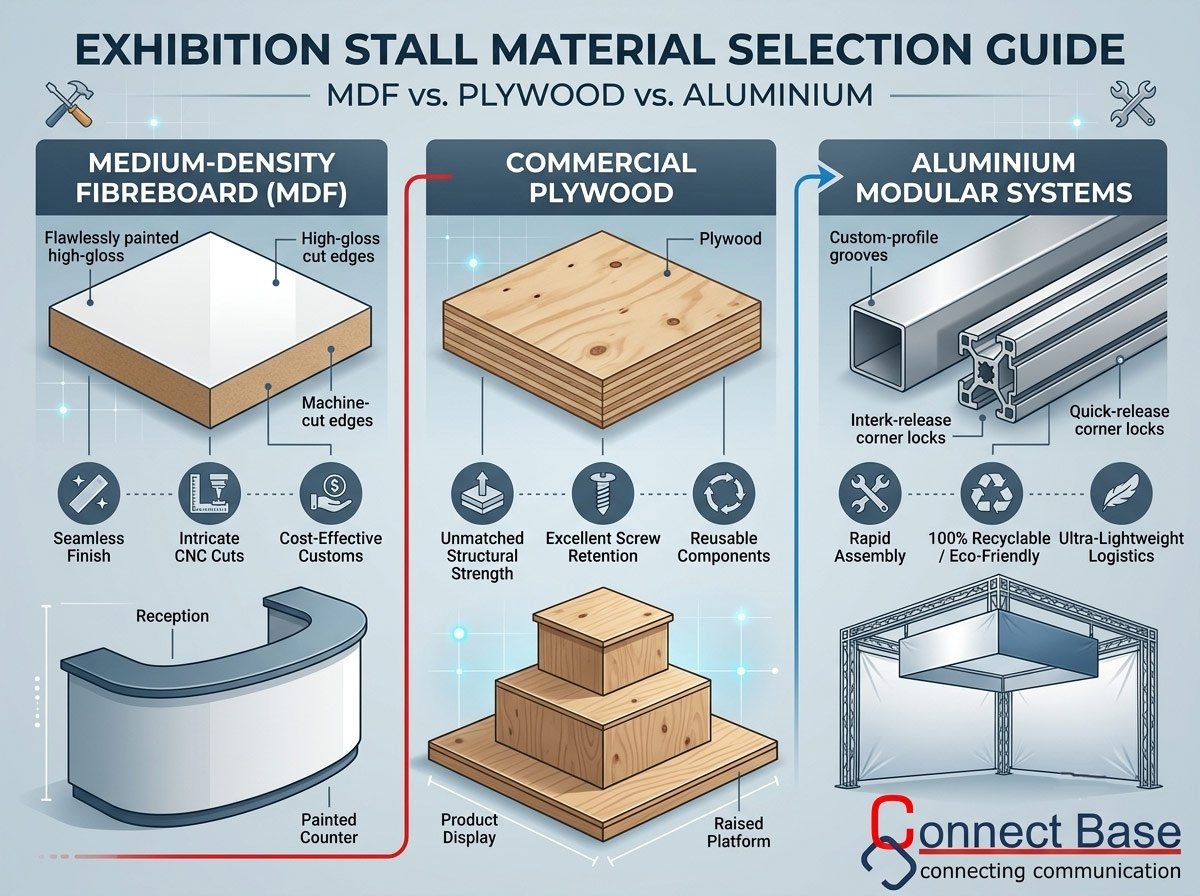
Medium-Density Fibreboard (MDF) is an engineered wood product made by breaking down hardwood or softwood residuals into wood fibers, combining them with a resin binder, and forming panels by applying high temperature and pressure. It is widely recognized as the industry standard for creating sleek, highly customized, contemporary exhibition stands.
The Advantages of MDF in Exhibition Fabrication
Flawless, Seamless Finishes: Unlike natural wood or plywood, MDF has no knots, rings, or grain patterns. Its surface is perfectly uniform and smooth. This makes it an exceptional base for high-gloss paint finishes, premium primers, or large-scale vinyl graphics. When your stall design demands large, unbroken expanses of solid brand color, MDF delivers a pristine appearance.
Intricate Customization and CNC Router Precision: Because MDF is consistent throughout its core, it can be cut, drilled, and machined without fracturing, splitting, or splintering. Our fabrication team utilizes advanced computer-controlled CNC routing machines to carve intricate 3D patterns, sweeping geometric curves, back-lit recessed channels, and custom display panels effortlessly out of MDF sheets.
Cost-Efficiency for Single-Use Customs: MDF is generally more affordable than high-grade commercial plywood. If you are designing a highly customized, intricate, one-off stand meant for a single mega-event, MDF provides a premium appearance at a competitive price.
The Limitations of MDF
Weight and Structural Handling: MDF is dense and significantly heavier than plywood or aluminum. This high density makes large panels difficult to handle on-site, increasing labor requirements during installation and driving up transportation weight costs.
Low Structural Tensile Strength: MDF lacks the internal layered grain structure of plywood. As a result, it is prone to sagging if used for long, unsupported horizontal spans, heavy-duty shelving, or primary load-bearing beams.
Zero Moisture Resistance: Exhibition halls are indoor environments, but transport and outdoor loading docks expose materials to changing weather. Raw MDF acts like a sponge when exposed to humidity or water, swelling and warping unpredictably. It requires professional priming and sealing to safeguard its structural integrity.
2. Commercial Plywood
Plywood is an engineered wood panel constructed by gluing together thin layers of wood veneers (plies) stacked at alternating 90-degree angles. This cross-graining technique gives plywood immense structural strength and resilience, making it the preferred choice for heavy-duty structural builds and complex multi-story exhibition architecture.
The Advantages of Plywood in Exhibition Fabrication
Unmatched Structural Integrity and Weight Capacity: The alternating grain layers of plywood distribute weight and stress evenly in all directions. Plywood will not warp, sag, or snap under pressure. This makes it the essential material for building heavy-duty product display counters, raised flooring platforms, multi-tiered stages, or massive structural back-walls that need to support heavy LED video screens.
Excellent Screw-Holding Capacity and Reusability: Plywood handles fasteners, screws, brackets, and nails beautifully. Screws bite into the cross-grained layers securely without crumbling the core. If you plan to dismantle your custom stall and reuse key architectural elements across multiple trade shows throughout the year, plywood panels hold up to repeated assembly and disassembly far better than MDF.
Lighter Weight Profiles: Despite being structurally stronger, high-grade commercial plywood is noticeably lighter than MDF sheet-for-sheet. This reduces the total weight of your crated cargo, helping lower logistics and freight costs.
The Limitations of Plywood
Surface Imperfections and Visible Grain: Because plywood is made from natural wood veneers, its surface often features tiny ridges, grain textures, patches, or voids. Achieving a mirror-smooth, high-gloss paint finish directly on raw plywood is incredibly labor-intensive. It requires extensive wood filling, sanding, and priming by skilled craftsmen to prevent the natural grain from bleeding through.
Edge Sealing Challenges: The exposed edges of a cut plywood sheet reveal distinct, visible layers. To make a corner look clean, fabricators must apply edge-banding strips or use complex miter cuts, which can increase pre-fabrication time in the workshop.
Premium Price Points: High-quality moisture-resistant (MR) or commercial plywood carries a higher upfront cost than standard MDF, which can impact overall budgets for large, sprawling stall layouts.
3. Aluminium Modular Extrusions & Systems
Aluminium stands apart from wood alternatives. In modern exhibition fabrication, aluminum is used in the form of engineered structural profiles and modular framing systems (such as Maxima, Octanorm, or custom fabric tension matrix frames). It represents the pinnacle of modern, agile, sustainable exhibition engineering.
The Advantages of Aluminium in Exhibition Architecture
Rapid Deployment and Lightning-Fast Assembly: Time is your tightest constraint on an exhibition floor, with setup windows often limited to 24-48 hours. Aluminium modular components lock together using simple, standardized tension locks, hex keys, or quick-release clamps. A massive aluminum structure can be raised in a fraction of the time it takes to build, screw, and patch a traditional wooden wall panel.
Eco-Friendliness and Infinite Reusability: Aluminium structures are inherently sustainable. A single set of aluminum frames can be reconfigured into hundreds of different booth shapes and sizes over a decade, leaving zero material waste. Combined with eco-friendly fabric tension graphics, it is the perfect solution for brands seeking sustainable exhibition options.
Ultra-Lightweight and Scalable Logistics: Aluminium boasts an exceptional strength-to-weight ratio. It allows for the creation of massive overhead hanging branding rings, towers, and spans without creating excessive structural weight load. This translates directly to significant savings on freight shipping and venue rigging fees.
The Limitations of Aluminium
Rigid Geometric Constraints: Modular aluminum systems rely on standardized lengths, grids, and angles (typically 45, 90, or 135 degrees). If your design vision calls for sweeping organic curves, fluid free-form shapes, or intricate custom molding, modular aluminum systems can feel restrictive.
A Standardized, Commercial Appearance: If left exposed, classic aluminum frames can look industrial or generic, reminiscent of standard shell schemes. To achieve a premium, high-end bespoke look, aluminum frameworks must be creatively concealed using seamless fabric graphics or integrated wood composite panels.
High Initial Capital Investment: Sourcing premium, precision-engineered aluminum extrusion systems carries a higher initial cost per component compared to buying raw wood sheets.
Moderate. Reusability helps extend the overall lifecycle of wood panels.
Excellent. 100% recyclable material with a long operational life.
Bringing Strategy to Reality with Exhibition 3d Stall Design Services
You do not have to guess which material combination is right for your project. At Connectbase Communications, we utilize specialized Exhibition 3d Stall Design Services to help you visualize structural choices early in the planning process.
By building a precise digital twin of your booth, our designers can simulate material attributes directly within photorealistic renders. This allows you to evaluate your options clearly:
Visualizing the Finishes: See exactly how a flawless high-gloss MDF counter interacts with a matte fabric backdrop draped over an aluminum frame under simulated expo lighting.
Engineering Structural Integrity: We calculate stress points and support paths in the 3D model, determining exactly where plywood reinforces an active display zone and where lightweight materials optimize overhead spaces.
Optimizing Component Modularization: If you want a booth that can be converted from a 6×6 meter island to a 3×3 meter inline space, we can map out the modular segments in 3D to ensure your graphics and walls transition smoothly.
Finding the Sweet Spot: The Hybrid Approach
The most cost-effective and visually striking exhibition stalls rarely rely on just one material. Instead, they leverage a hybrid material strategy that assigns each option to its ideal structural role:
The Core Framework & Overhead Structure: Use lightweight Aluminium Systems to create a strong, safe frame and support overhead hanging signs without driving up venue rigging costs.
The Structural Walls & Raised Floors: Use heavy-duty Commercial Plywood to build rock-solid raised flooring planks and structural wall backdrops capable of supporting heavy AV media screens and product displays.
The Front-Facing Visual Elements: Use precisely routed MDF for front reception desks, illuminated display cases, product pedestals, and customized focal points that demand an absolute mirror-smooth finish.
Why Partner with Connectbase Communications?
Navigating material specifications, weight limitations, and structural fire codes requires an experienced partner who can bridge the gap between creative design and workshop execution.
When you collaborate with Connectbase Communications, you gain access to a dedicated team of spatial designers and expert fabricators. We don’t believe in cookie-cutter answers. We carefully analyze your target audience, show frequency, sustainability goals, and budget to select the ideal material combination. From initial photorealistic 3D renders to precise pre-fabrication in our workshop and final on-site handovers, we deliver turnkey solutions that help your brand stand out.
Frequently Asked Questions (FAQ)
Which material is best if I want to reuse my stall for 3-4 expos a year?
A combination of Aluminium framing and Plywood wall panels is highly recommended. Aluminium handles frequent assembly and teardown without wear, while plywood retains its screw-holding strength through multiple events far better than MDF.
Can MDF withstand the weight of a heavy LED video wall screen?
We advise against mounting heavy, high-value LED video walls directly to an unsupported MDF wall sheet. Plywood or integrated structural iron/aluminum framing should always be used as the internal backbone to bear significant structural loads safely.
How do material choices affect venue fire safety compliance?
Most international exhibition centers have strict fire safety guidelines. Raw wood materials like MDF and Plywood must be coated with certified fire-retardant primers or fire-resistant laminates during fabrication. Aluminium is naturally non-combustible, making it highly compliant right out of the box.
Ready to engineer your next trade show success?
Let’s choose the ideal material strategy to bring your brand’s physical presence to life beautifully and efficiently.
Design with precision: Reach out to our design and fabrication teams today to discover how our tailored Exhibition Stall Design Services and high-quality Exhibition Stall Fabrication Services can help you deliver a flawless presentation at your next show.

 +91 7600576410